AI Generated Image
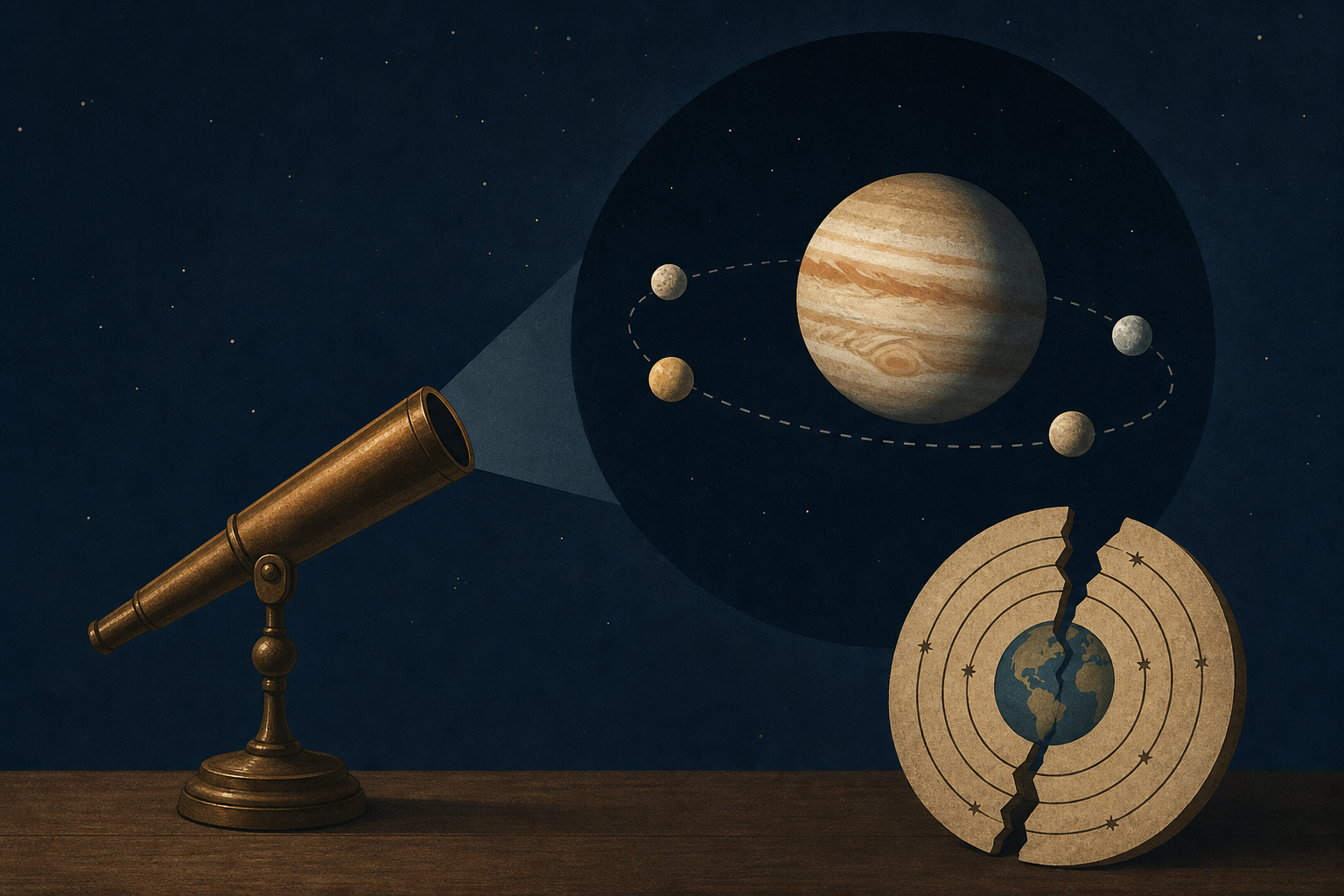
In 1610, Galileo pointed a small telescope at Jupiter and saw four moons orbiting it — a direct contradiction of the idea that everything in the universe orbited Earth, and a moment that did more to e
Space Daily • • science
Key Points:
- In January 1610, Galileo Galilei discovered four moons orbiting Jupiter using a telescope, challenging the long-held geocentric belief that all celestial bodies revolve around the Earth.
- This observation provided direct evidence that not everything in the cosmos revolves around Earth, undermining the Aristotelian-Ptolemaic model endorsed by the Church for over fifteen centuries.
- Although the discovery did not immediately prove the heliocentric model, it weakened objections to Earth's motion and paved the way for further evidence, such as Venus's phases, supporting the Sun-centered system.
- Galileo's findings marked a shift from theoretical argument to empirical observation in astronomy, allowing anyone with a telescope to verify celestial phenomena, thus transforming scientific inquiry.
- The revelation of Jupiter's moons initiated a gradual but profound change in cosmological understanding, ultimately leading to the decline of the Earth-centered universe despite Galileo facing significant opposition and persecution.


