AI Generated Image
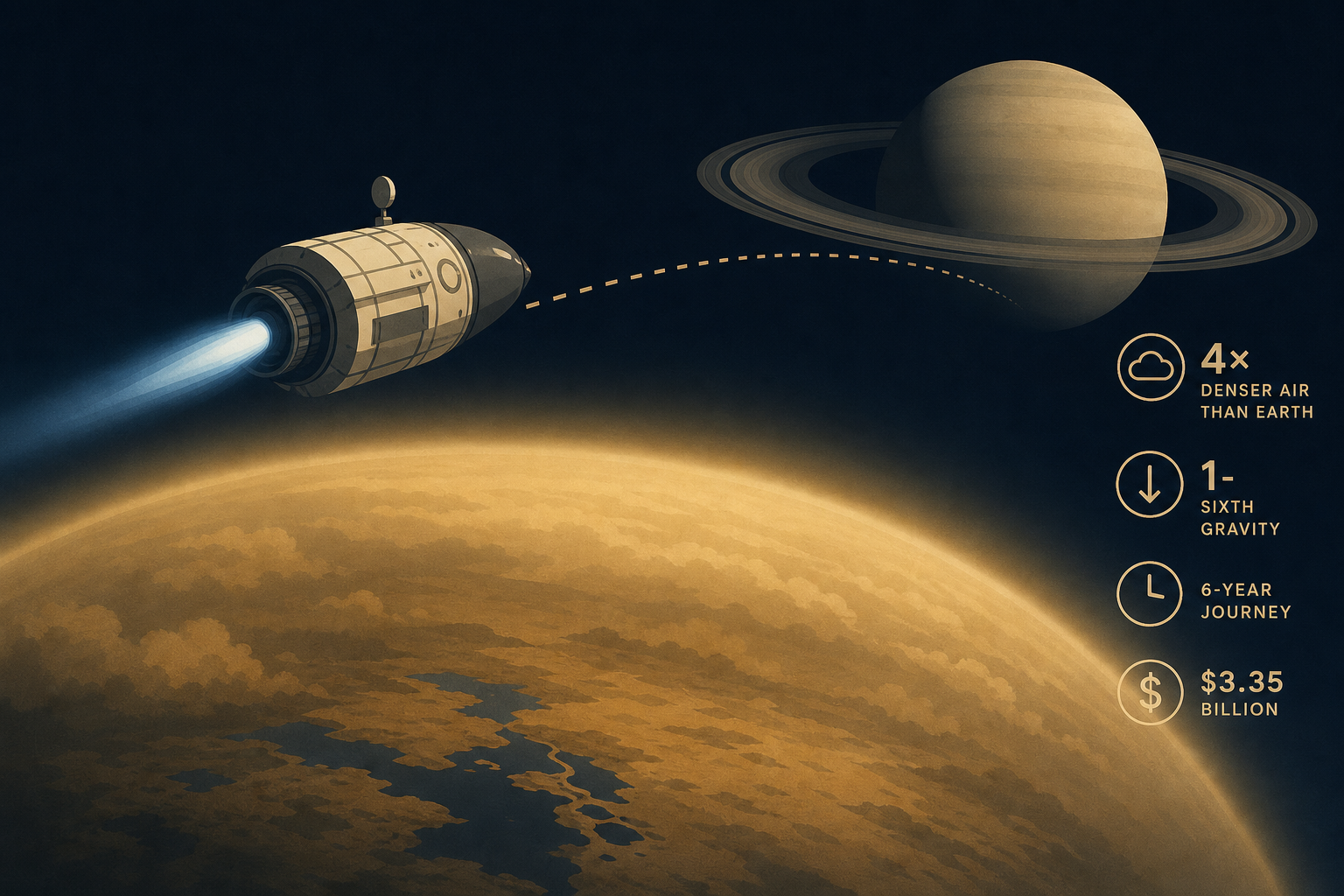
In July 2028 NASA launches a car-sized, 1,000-pound nuclear drone toward Saturn’s moon Titan, a six-year, $3.35 billion trip to a world where the air is four times denser than Earth’s, gravity is one-
19FortyFive • • science
Key Points:
- NASA's Dragonfly mission, set to launch in July 2028 with a budget of approximately $3.35 billion, will deploy a nuclear-powered drone to fly across Saturn’s moon Titan, marking a significant shift from traditional rover-based planetary exploration.
- Titan is unique for its dense atmosphere, liquid methane and ethane lakes, and potential subsurface water ocean, making it an ideal candidate for aerial exploration due to its thick atmosphere and low gravity.
- Dragonfly is a 1,000-pound, eight-rotor aircraft powered by a plutonium-based MMRTG, enabling continuous electricity generation and heating in Titan’s extremely cold environment, where solar power is insufficient.
- The mission will involve autonomous flights lasting about 30 minutes, covering several kilometers between landings, with onboard systems including cameras, LiDAR, and navigation software to independently manage flight and hazard avoidance.
- Scientific goals focus on analyzing Titan’s organic chemistry and potential prebiotic conditions using instruments like a mass spectrometer, gamma-ray/neutron spectrometer, cameras, and a weather and geophysics package, potentially advancing understanding of life’s origins in the Solar System.


