AI Generated Image
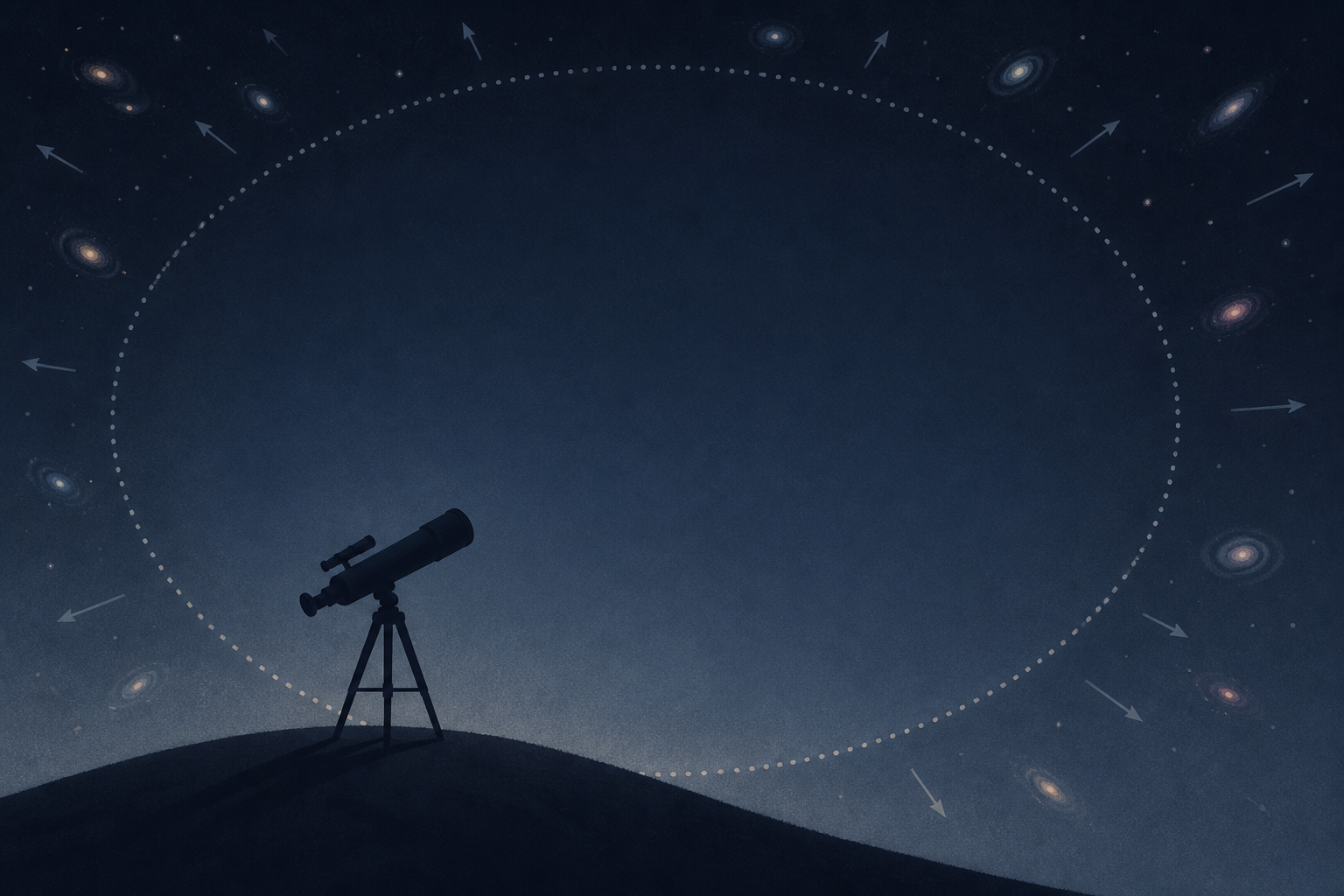
In the far future the expansion of space will carry every other galaxy beyond the reach of our telescopes, leaving the astronomers of that era with an empty sky and no way to ever discover that the Bi
Space Daily • • science
Key Points:
- The universe's expansion is accelerating due to dark energy, causing distant galaxies to move away faster than light can bridge the gap, eventually making their light undetectable to observers in the far future.
- Over the next hundred billion to trillions of years, galaxies outside our Local Group will disappear beyond the cosmic horizon, leaving a single merged galaxy in an apparently empty void.
- Key evidence for the Big Bang—the redshift of galaxies, the cosmic microwave background, and primordial element ratios—will vanish, leading future astronomers to conclude they live in a static, eternal universe.
- This scenario highlights the limits of observational knowledge, suggesting current observers live in a unique window where the universe's origins remain visible, but past and future observers may not have the same information.
- The outcome depends on dark energy's behavior remaining constant; if it changes, the timeline and cosmic fate could differ, and civilizations preserving knowledge could retain understanding of the Big Bang despite observational limitations.


