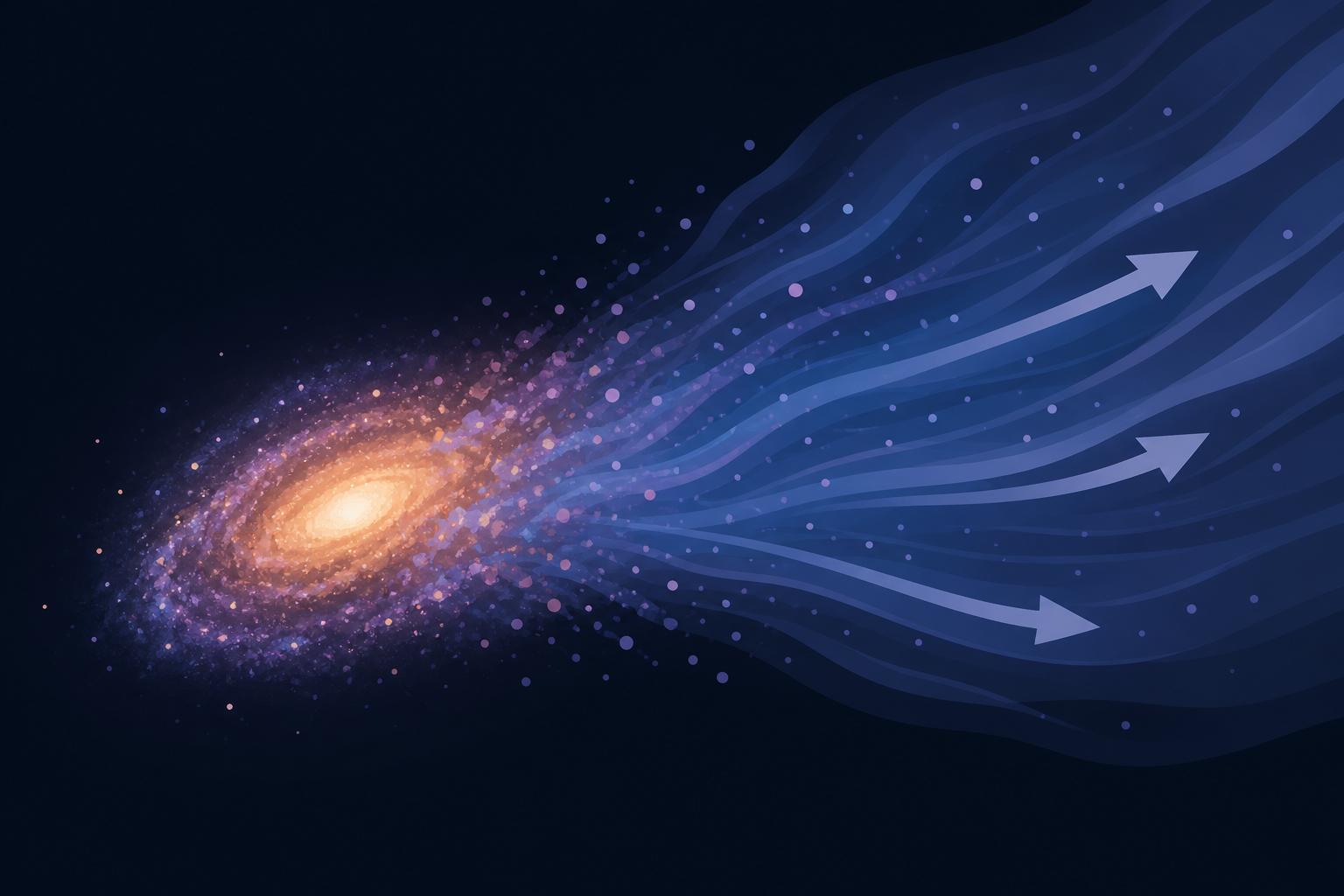
AI Generated Image
James Webb telescope detects 'galaxy-killing wind' near the dawn of time
Live Science • • general
Key Points:
- Astronomers observed a galactic merger, CRISTAL-02, just 1 billion years after the Big Bang, revealing powerful star-driven winds ejecting massive amounts of gas and suppressing star formation.
- This finding helps explain why many early massive galaxies grew quickly but then became quiescent within about a billion years, a phenomenon previously lacking direct evidence.
- The study suggests that intense stellar winds from rapid star formation and supernovae can quench galaxies by dispersing cool gas needed for new stars, potentially leading to their "death."
- Researchers noted that this star-driven outflow process is widespread in early galaxies and has remained consistent over cosmic time, influencing galactic evolution models.
- The results also provide insight into future events like the expected Milky Way-Andromeda collision, which may trigger similar starbursts and eventual quiescence in the resulting galaxy.


