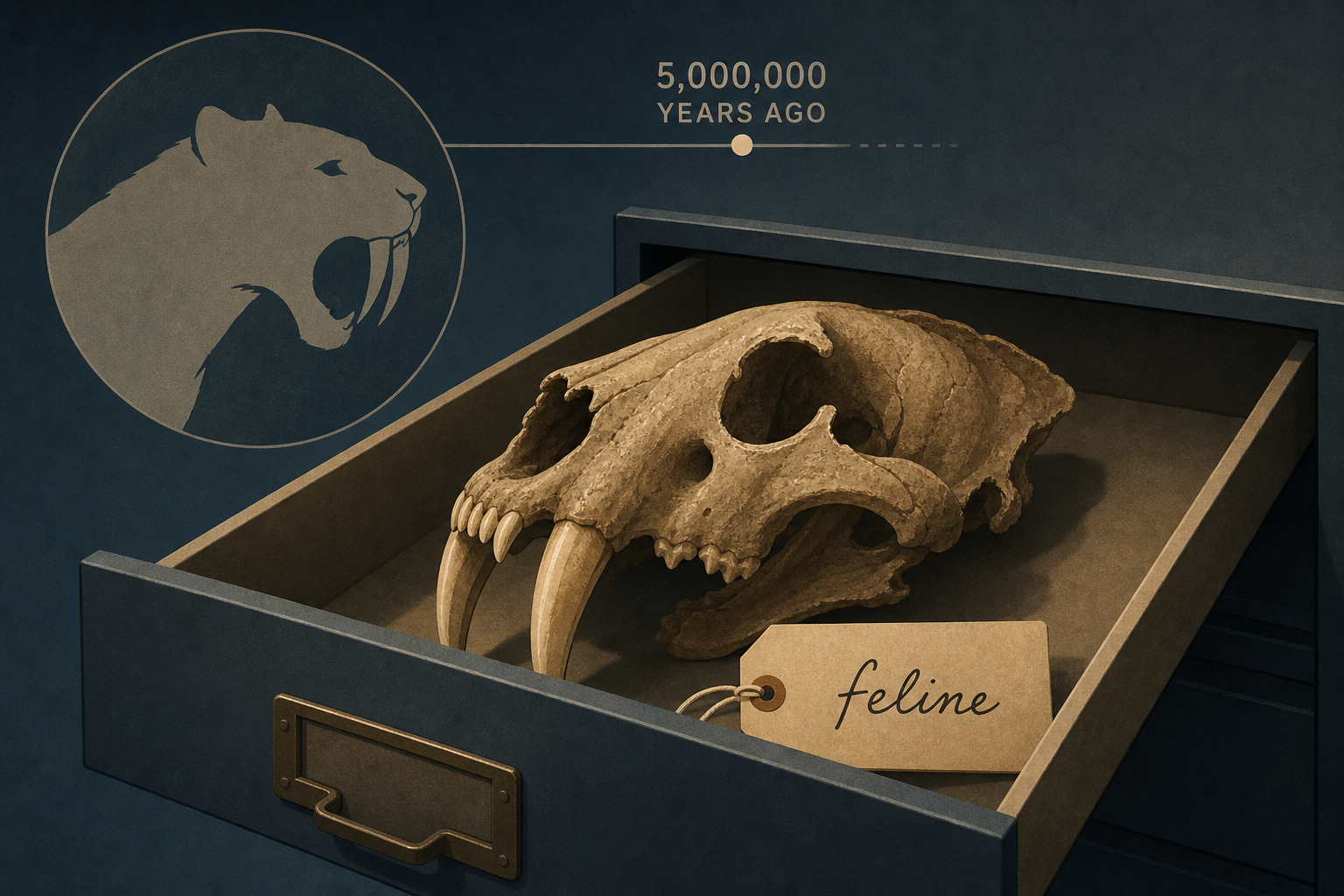
AI Generated Image
Labeled just 'feline,' skull in a New York museum drawer turns out to be a 5-million-year-old saber-toothed cat
Yahoo • • science
Key Points:
- A 5-million-year-old saber-toothed cat fossil, identified as Adelphailurus kansensis, was rediscovered in a drawer at the American Museum of Natural History by postdoctoral researcher Narimane Chatar from UC Berkeley.
- This specimen represents the first fully complete skull of the species, previously known only from jaw fragments and isolated teeth, providing new insights into saber-toothed cat evolution.
- The study, published in the Journal of Vertebrate Paleontology, suggests that the evolution of specialized, fragile upper canines in saber-toothed cats may have contributed to their extinction after the last ice age when large prey became scarce.
- Saber-toothed cats' upper canines were highly efficient for slicing flesh but prone to breaking, reflecting a tradeoff in carnivore tooth evolution between slicing and crushing abilities.
- Researchers note that once saber-toothed lineages developed elongated upper canines, they continued to specialize until extinction, indicating an evolutionary dead-end linked to their feeding adaptations.


