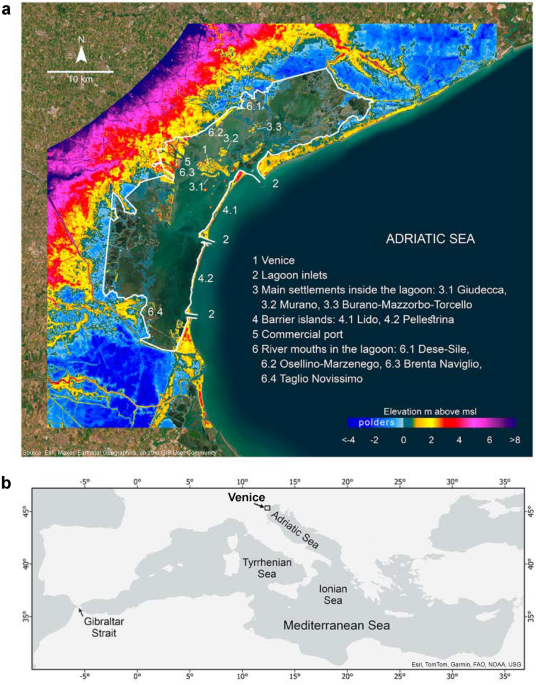
Long-term adaptation pathways for Venice and its lagoon under sea-level rise
Nature • • world
Key Points:
- Four main adaptation strategies to address sea-level rise (SLR) risks in Venice are identified: open lagoon (using mobile barriers like MoSE), ring-diking (isolating the city with dikes), closed lagoon (transforming the lagoon into a coastal lake), and retreat (planned relocation or abandonment). Each strategy varies in costs, effectiveness, and preservation of social, economic, environmental, and cultural values.
- The open lagoon strategy currently preserves most values but its effectiveness declines with increased SLR due to more frequent barrier closures, leading to ecosystem degradation, port disruptions, and high operational costs; accommodation measures like land uplift and building modifications can extend its viability but not indefinitely.
- Ring-diking preserves monuments and economic activities while allowing lagoon ecosystems to evolve naturally, but alters the city-lagoon connection and requires costly dike construction and pumping systems; closed lagoon maximizes urban protection but irreversibly damages the lagoon ecosystem and demands very high infrastructure investments.
- Retreat involves relocating or abandoning parts of Venice, preserving only select monuments but causing irreversible loss of cultural heritage, urban fabric, and economic activities; it is the most costly in terms of social and economic impacts and likely only feasible under very high SLR scenarios.
- Adaptation pathways outline transitions between strategies based on SLR thresholds and tipping points, emphasizing the need for timely decisions due to long lead times for interventions; preserving Venice’s unique cultural, environmental, and economic values requires balancing trade-offs, with no single optimal solution, and highlights broader global coastal adaptation challenges.


