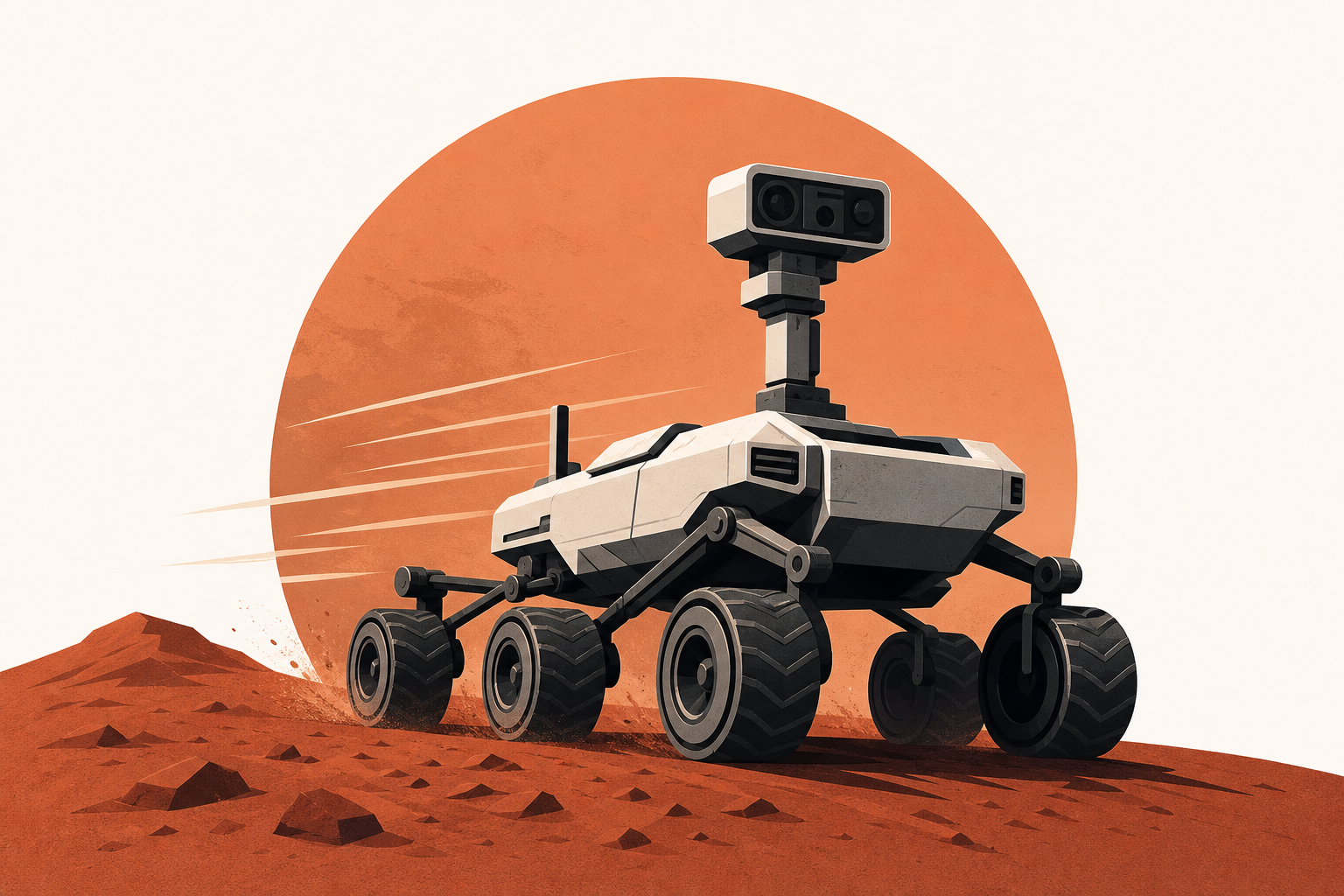
AI Generated Image
Meet ERNEST, NASA's Next-Generation Rover Designed to Be Faster and Tougher
Gizmodo • • general
Key Points:
- NASA’s Jet Propulsion Laboratory tested ERNEST, a small four-wheeled prototype rover, in the Colorado desert where it autonomously traveled 16 miles over 37 hours, demonstrating enhanced obstacle navigation and decision-making capabilities.
- ERNEST is designed as a next-generation rover with advanced mobility features such as a suspension system for weight distribution, steerable wheels for multidirectional movement, and powered joints enabling various gaits like wheel-walking and obstacle-climbing.
- The rover operates at speeds up to 0.6 miles per hour, significantly faster than current Mars rovers Curiosity and Perseverance, making it suitable for future missions requiring higher speed and greater mileage on rugged terrains of the Moon and Mars.
- ERNEST uses reinforcement learning, a form of artificial intelligence, to autonomously navigate complex environments, which was validated through obstacle courses and field tests including low-light conditions simulating lunar dawn and dusk.
- The successful testing of ERNEST paves the way for developing larger, faster versions that could be deployed on upcoming planetary missions to explore previously inaccessible regions.


