AI Generated Image
Mission to solve Mercury’s mysteries nears arrival after 8 years
CNN • • general
Key Points:
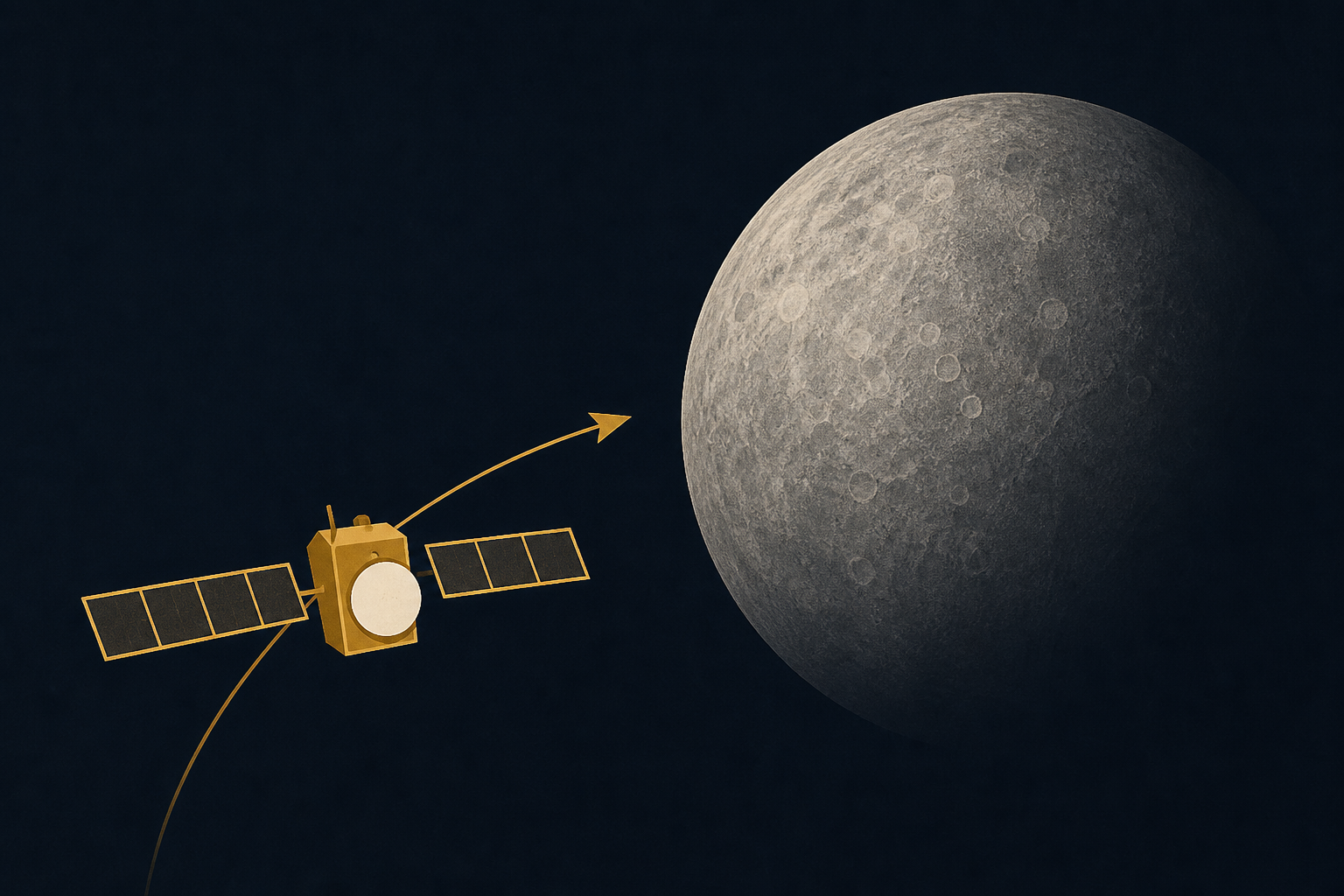
- The BepiColombo mission, a collaboration between the European Space Agency (ESA) and Japan Aerospace Exploration Agency (JAXA), is arriving at Mercury after a six-year journey covering over 6 billion miles, aiming to study the planet's formation and evolution near the sun.
- The spacecraft consists of two orbiters, ESA’s Mercury Planetary Orbiter (MPO) and JAXA’s Mercury Magnetospheric Orbiter (MIO), which will enter Mercury’s orbit in November and December respectively, marking the first time two independent spacecraft will orbit another planet simultaneously.
- The mission faces significant challenges due to Mercury's proximity to the sun, including extreme temperatures up to 800°F (430°C) and the need for complex orbital insertion maneuvers using electric propulsion and multiple gravitational flybys.
- BepiColombo will investigate Mercury’s surface features, magnetic field, exosphere, and mysterious hollows—unique depressions not found on other planets—to better understand the planet’s high density and geological history.
- Science operations for both orbiters are set to begin in April, with the mission expected to provide unprecedented insights into Mercury’s structure, composition, and its role in the early solar system.


