AI Image
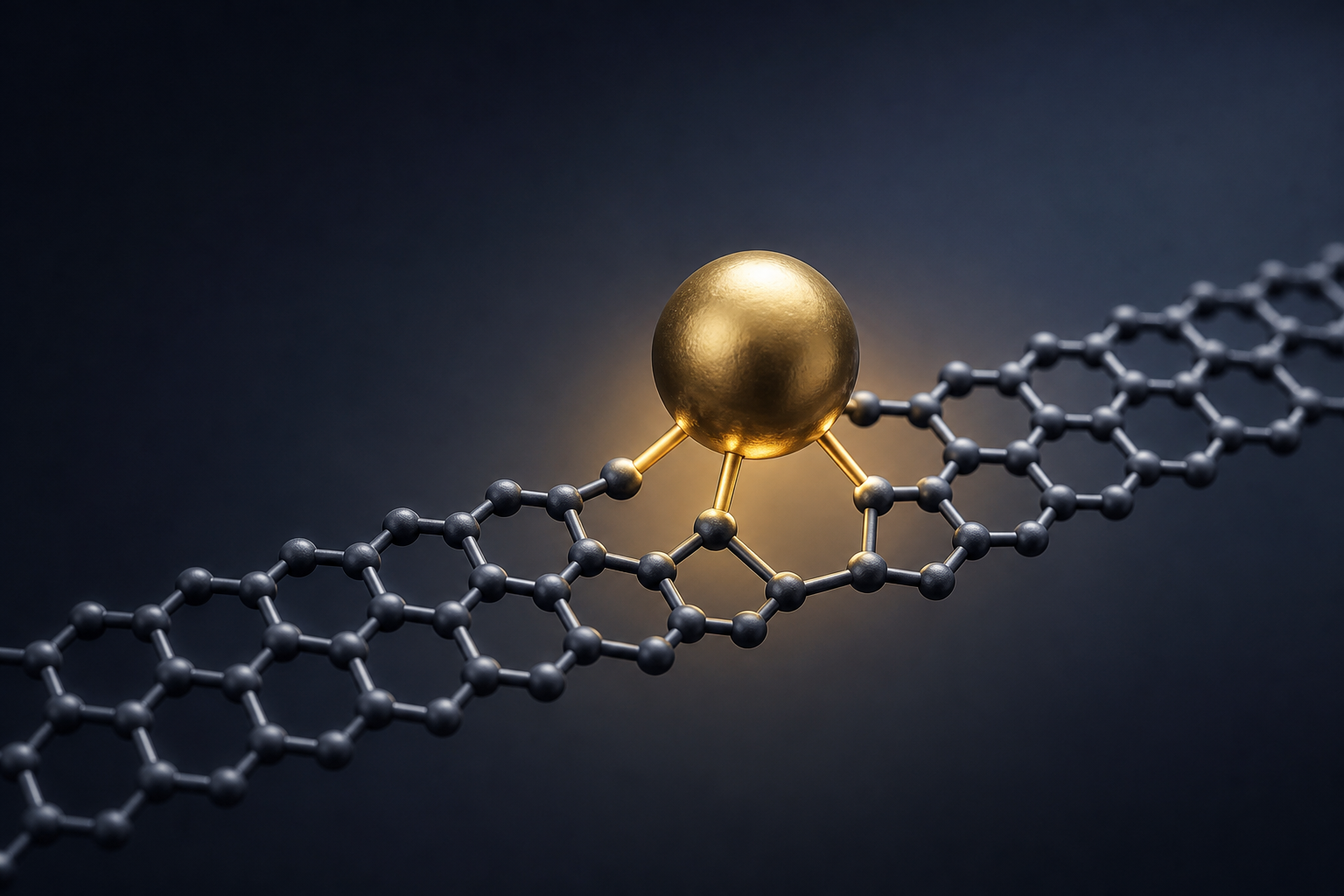
Narrow carbon pentaheptite nanoribbon as a covalent metal
Nature • • science
Key Points:
- Two types of 2D carbon pentaheptite sheets (CPHN 1 and CPHN 2) were structurally modeled, derived from graphene by a 90° in-plane rotation of central bonds in pyrene units, differing in pentalene chain orientations and separated by zigzag heptagon chains.
- Non-contact AFM (nc-AFM) and STM imaging confirmed the presence of both CPHN 1 and CPHN 2 nanoribbons with no obvious selectivity, showing detailed atomic structures and electronic properties on Ag(111) surfaces.
- Calculated reaction pathways using CI-NEB simulations revealed similar activation barriers (~1.23–1.25 eV) for the lateral fusion of polypentalene chains into CPHN 1 and CPHN 2, indicating feasible synthesis routes.
- Lifting experiments with STM tips demonstrated stable electrical contact and conductance changes for individual CPHN 1 and CPHN 2 nanoribbons, enabling two-electrode device construction and characterization of transport properties.
- Spin-polarized and spin-unpolarized DFT calculations, combined with STM/STS measurements, elucidated the band structures, spin densities, and electronic states of CPHNs and their wider analogs ([3]CPHNs), showing tunable electronic properties influenced by substrate interactions and ribbon termini.


