AI Generated Image
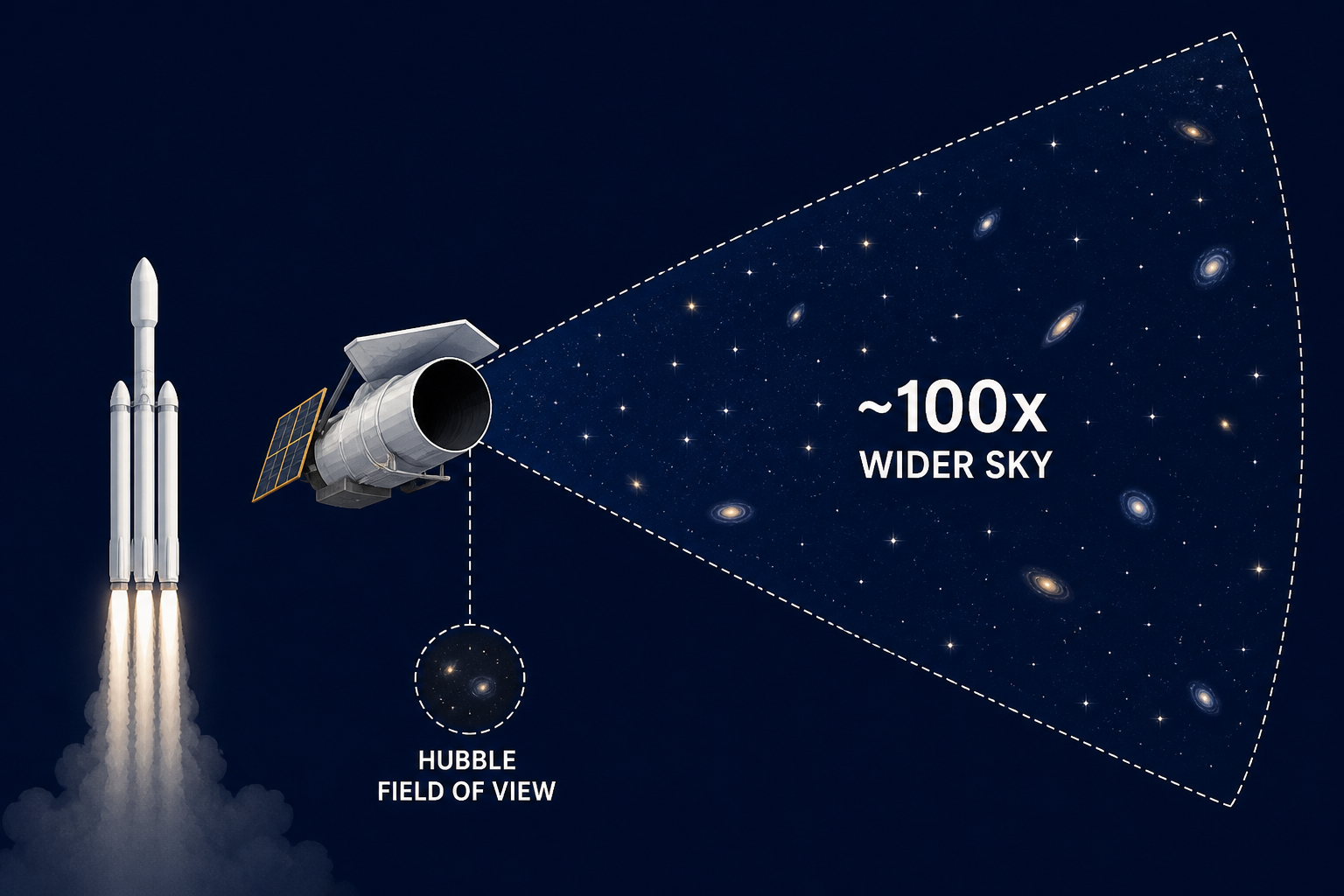
NASA's Nancy Grace Roman Space Telescope, launching on a Falcon Heavy on 30 August 2026, carries a mirror the size of Hubble's but sees a patch of sky about a hundred times wider, built mainly to map
Space Daily • • general
Key Points:
- NASA’s Nancy Grace Roman Space Telescope is completed, fueled, and set to launch on 30 August 2026 aboard a SpaceX Falcon Heavy, ahead of its original May 2027 schedule.
- The telescope features a 2.4-meter mirror, the same size as Hubble’s, but with a Wide Field Instrument that captures a sky area 100 times larger than Hubble in a single exposure, enabling rapid, detailed sky surveys.
- Roman’s main scientific goals are to study dark energy by surveying about a billion galaxies to measure cosmic expansion and to discover over a thousand exoplanets via gravitational microlensing in the Milky Way’s crowded star fields.
- It also carries a technology demonstration coronagraph designed to block starlight and directly image exoplanets, advancing future missions aimed at photographing Earth-like worlds, although this is an experimental instrument rather than a core survey tool.
- Having completed rigorous pre-launch testing early, Roman will travel to the second Lagrange point after launch and undergo months of commissioning before beginning its wide-field sky surveys, which may take years to fully reveal new insights.


