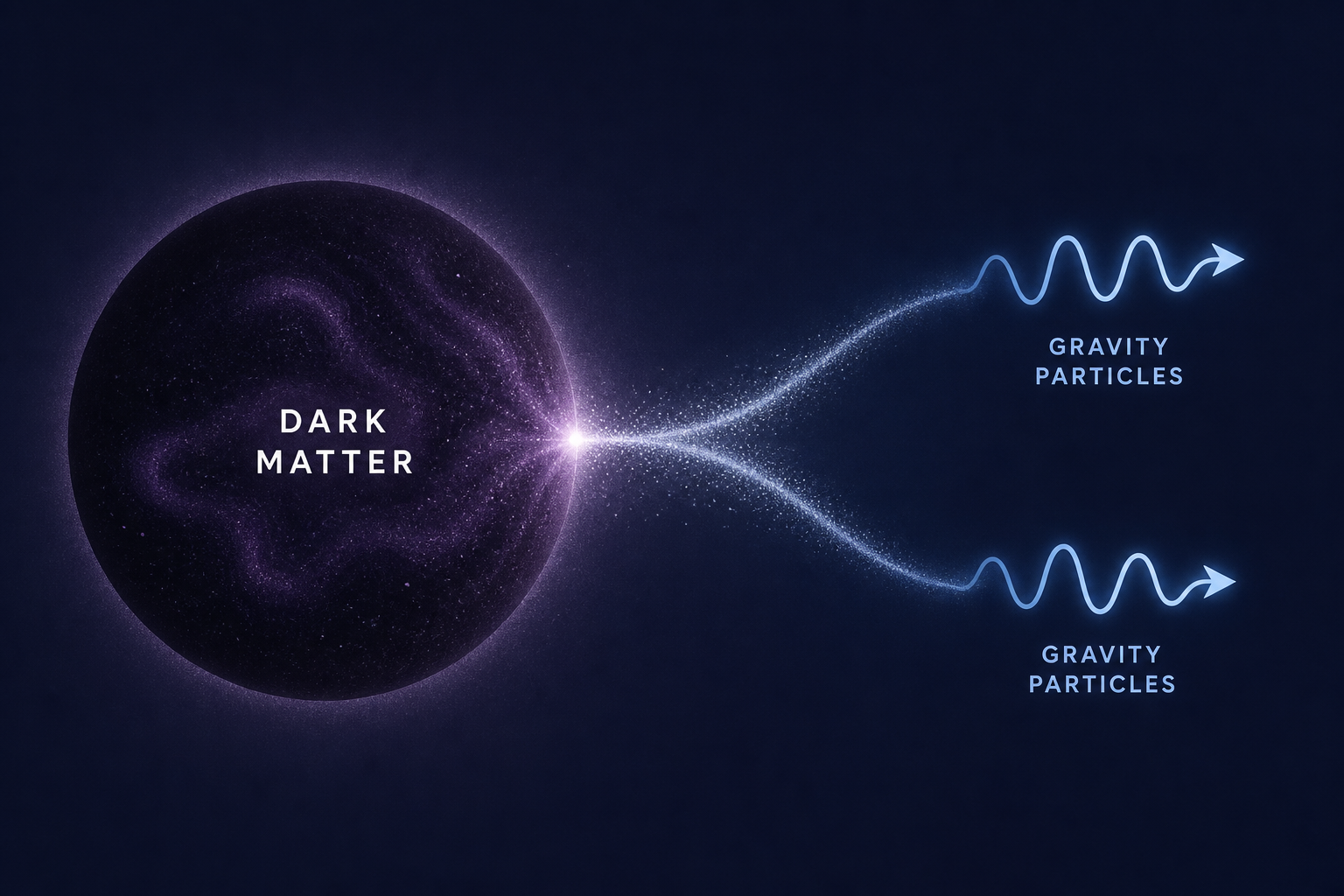
AI Generated Image
There Might Be a Way to Observe Dark Matter Decaying Into Gravity Particles
ScienceAlert • • health
Key Points:
- Visible matter, such as stars and galaxies, accounts for only about 15% of the Universe's matter, with the majority being invisible dark matter that interacts primarily through gravity.
- Traditional dark matter detection methods have failed, prompting researchers to propose searching for dark matter decaying into hypothetical gravitons, which could then convert into photons via the Gertsenshtein effect in cosmic magnetic fields.
- This decay and conversion process is expected to occur in the large-scale magnetic fields of cosmological filaments, which make up a significant portion of the observable Universe and have coherent but extremely weak magnetic fields.
- Detection would rely on observing an excess of gamma rays from extragalactic sources using instruments like the Fermi Gamma-ray Space Telescope, shifting the search focus from galactic centers to intergalactic space.
- The proposed mechanism aligns with the Standard Model of particle physics except for the new hypothesis of dark matter decay to gravitons, and future telescopes like the Advanced Particle-astrophysics Telescope could enhance detection sensitivity.


