AI Image
New clues emerge for moon’s ancient magnetic field
CNN • • science
Key Points:
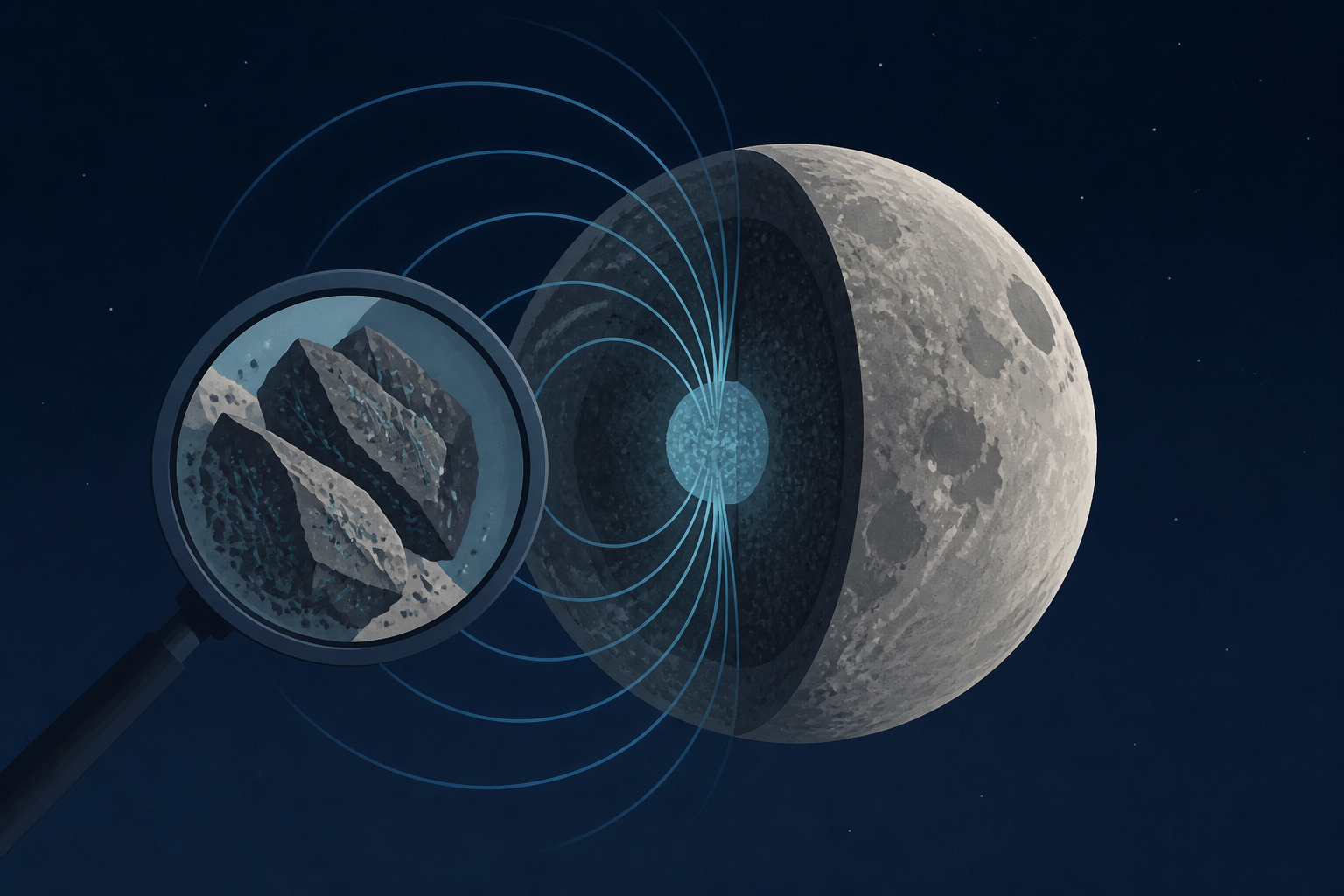
- Researchers discovered a dense, strongly magnetized rock formation about 60 km wide and 9 km deep on the far side of the moon, suggesting the moon once had a magnetic field around 4.2 billion years ago, possibly one-fifth to one-third the strength of Earth's current field.
- The study, published in Science Advances, used combined magnetic and gravity data from lunar probes rather than Apollo mission samples, addressing challenges with sample contamination and providing clearer evidence of an ancient lunar dynamo.
- Findings support the existence of a core-powered lunar magnetic field active from roughly 4.25 to 3.5 billion years ago, though how the small lunar core generated such a field remains unclear, shifting debate toward understanding the dynamo's mechanism.
- The research also noted a connection between magnetic anomalies and brighter lunar surface patches called swirls, which may shield areas from solar wind, offering potential targets for future lunar exploration missions.
- Experts highlight that this work motivates further lunar investigations through programs like NASA's Artemis and China's Chang’e, and could inform understanding of magnetic fields and planetary evolution on other celestial bodies such as Mercury and Mars.


