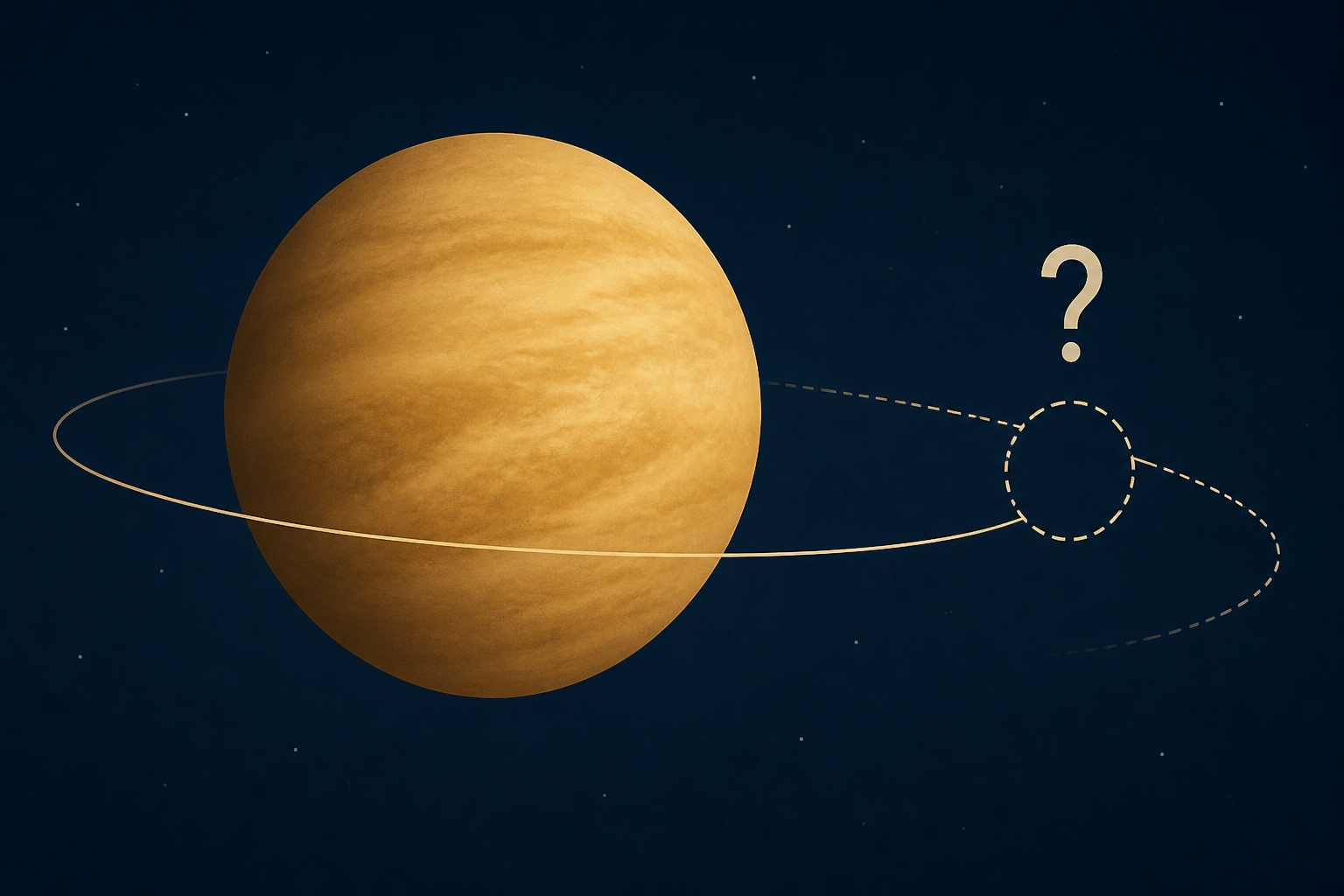
AI Generated Image
New Study Explains Why Venus Has No Moon
Sci.News • • science
Key Points:
- Researchers from the University of California, Riverside, led by Dr. Stephen Kane, used computer simulations to explain why Venus, despite its similarity to Earth, has no moon, showing that Venus’ slow rotation caused any moon to be pulled inward and destroyed by tidal forces.
- The study found that if Venus had spun rapidly after its formation, a moon could have survived for billions of years, but its actual slow retrograde rotation led to the moon’s collapse within 30 million to 1.7 billion years.
- Simulations of giant impacts suggest that collisions producing Venus’ slow spin also resulted in debris that either fell back onto the planet or formed moons at the edge of tidal survival, meaning no extra catastrophic event is needed to explain Venus’ moonless state.
- The findings imply that similar slowly rotating exoplanets close to their stars may also be unable to retain large moons, potentially affecting their climate stability and habitability, though Dr. Kane notes a moon is beneficial but not essential for habitability.
- This research, published in the Astrophysical Journal, highlights that many Earth-like planets may lose their moons if they do not rotate fast enough, which could significantly influence their evolutionary history.


