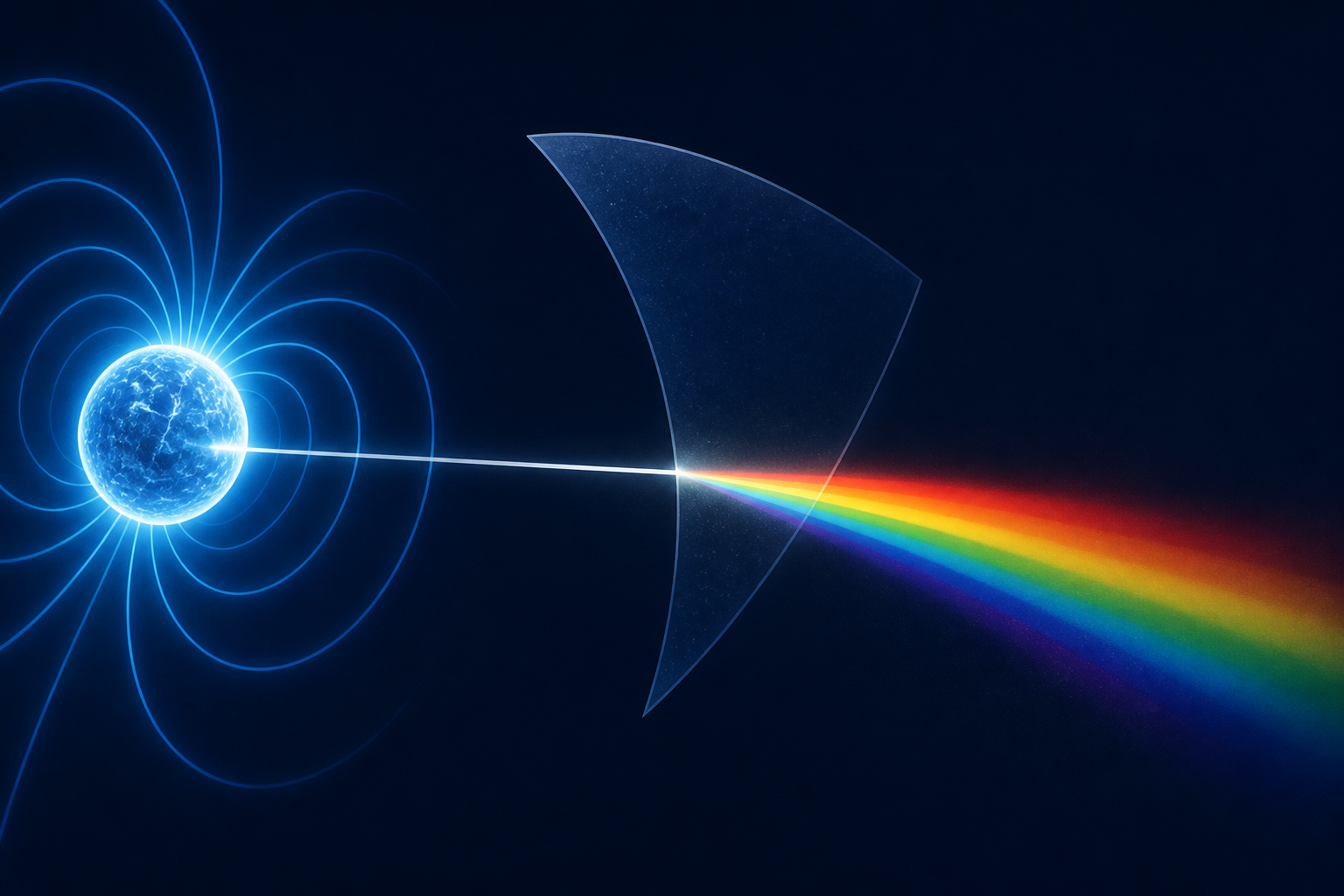
AI Generated Image
Physicists predicted in 1936 that a powerful magnetic field could turn empty space into a kind of prism — and on August 5, 2026, observations of a magnetar with a field more than a trillion times Eart
Space Daily • • science
Key Points:
- An international team using NASA’s IXPE telescope observed the magnetar 1E 1547.0−5408, about 13,000 light-years away, and found strong evidence for vacuum birefringence—a quantum effect where a strong magnetic field causes empty space to affect different polarizations of light differently.
- The X-ray polarization measured was far stronger and more coherent across the star’s rotation than standard models without vacuum birefringence could explain, and simultaneous radio polarization data from the Parkes telescope constrained the magnetar’s geometry, strengthening the case.
- Vacuum birefringence, predicted by Heisenberg and Euler in 1936 and grounded in quantum electrodynamics, implies that the quantum vacuum behaves like a birefringent medium under extreme magnetic fields, altering the polarization of passing photons without creating new photons or violating relativity.
- The magnetar’s magnetic field is about 22 billion tesla, vastly exceeding laboratory magnetic fields, making it a natural environment to test QED predictions that are otherwise unmeasurable on Earth; the study represents the strongest astrophysical evidence yet for this effect but is not definitive proof.
- Further observations, including repeated measurements and studies of other radio magnetars, alongside refined theoretical models, are needed to confirm and extend these findings and to better understand the complex magnetar environment and its influence on photon polarization.


