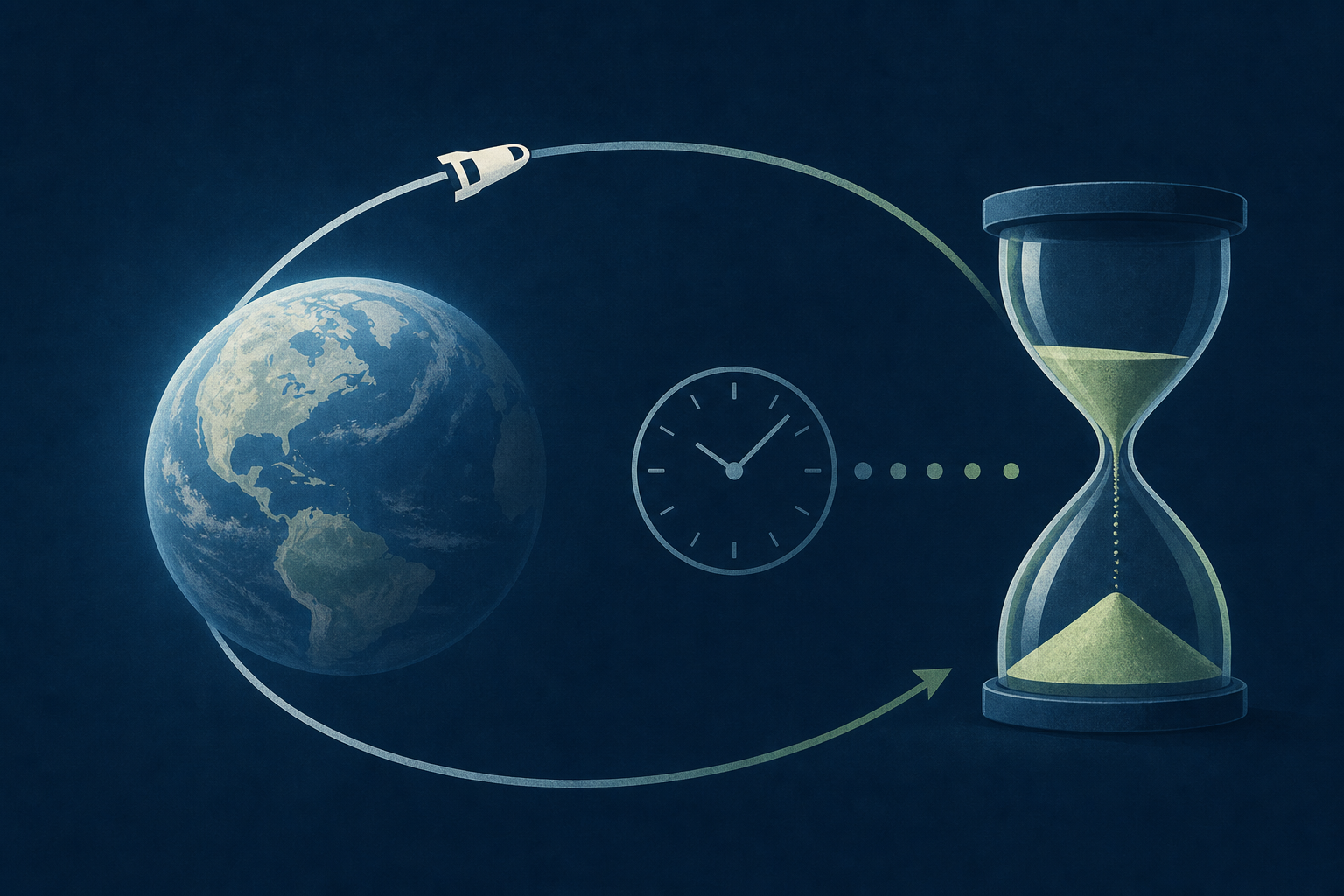
AI Generated Image
Physics says time travel into the future is not a thought experiment — every astronaut who has orbited Earth has returned a fraction of a second younger than they would have been if they had stayed on
Space Daily • • science
Key Points:
- Astronauts in low Earth orbit experience time slightly slower than people on Earth due to relativistic effects, causing them to age milliseconds less over months in space.
- This phenomenon results from two competing factors: special relativity slows time due to high orbital speed, while general relativity speeds time up due to weaker gravity at altitude; the speed effect dominates in low Earth orbit.
- The time difference is measurable with precise atomic clocks but medically insignificant compared to other spaceflight effects like radiation and microgravity.
- Experiments such as the Hafele-Keating 1971 airplane clock flights and modern optical atomic clocks have confirmed the predictions of relativity, which is also crucial for technologies like GPS.
- The concept illustrates that time travel into the future is physically possible through different paths in spacetime, though the effects at human spaceflight speeds remain extremely small.


