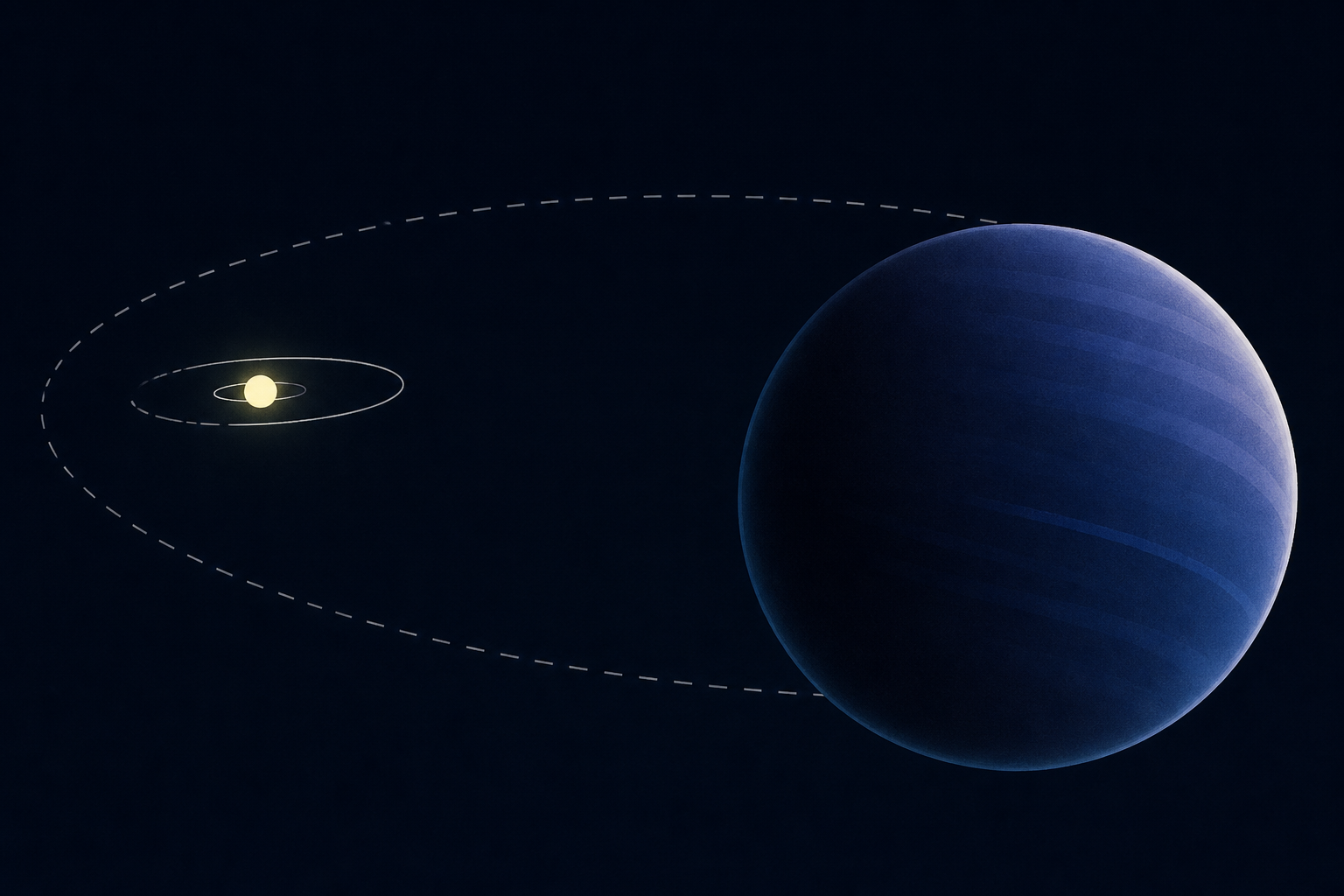
AI Generated Image
Planet Nine isn’t hiding because it would be small — if it exists, it may be several times Earth’s mass and more than twice as wide. But hundreds of times farther from the Sun than Earth, it receives
Space Daily • • science
Key Points:
- Planet Nine is hypothesized to be a large, cold sub-Neptune-sized planet several times Earth's mass, inferred from unusual orbits of distant Kuiper Belt objects, though it has not been directly observed in telescopes.
- Its great distance, estimated between 300 and 520 astronomical units (AU), drastically reduces reflected sunlight by factors of hundreds of thousands, making it extremely faint and difficult to detect despite its size.
- Reflected light from Planet Nine diminishes with the inverse fourth power of distance, meaning it would appear billions of times fainter than Earth does from the Sun, complicating direct imaging efforts.
- Extensive surveys like Pan-STARRS1 and others have ruled out 78% of the predicted parameter space for Planet Nine's location and brightness, but significant areas remain unexplored or too faint to detect.
- Upcoming observations from the Rubin Observatory's Legacy Survey of Space and Time, starting in 2026, aim to expand the catalog of distant Solar System objects and could confirm, constrain, or refute the Planet Nine hypothesis by refining orbital data and detection limits.


![Google just shared these fun Pixel 11 blueprint wallpapers [Gallery]](https://media-cdn.cashwalklabs.io/https%3A%2F%2Fs3.us-west-2.amazonaws.com%2Fimages.cashwalklabs.io%2F0_admin%2Fnews-ai-images%2F01a0a676-aa5b-745f-afa9-a51d34f7207e.webp?format=webp&w=120&h=80)


