Plasticity and language in the anaesthetized human hippocampus
Nature • • health
Key Points:
- Researchers recorded neural activity from the hippocampus of anesthetized epilepsy patients while playing natural speech podcasts, finding that hippocampal neurons encoded semantic and syntactic features of words, including lexical frequency, duration, and semantic category.
- Neural firing rates correlated positively with word frequency and semantic embeddings, and hippocampal neurons demonstrated selectivity for multiple semantic categories and parts of speech, showing similar patterns to those observed in awake patients.
- Support vector machine classifiers successfully decoded both semantic categories and parts of speech from single-trial hippocampal activity, indicating that the anesthetized hippocampus processes real-time linguistic information, including representations of past and upcoming words.
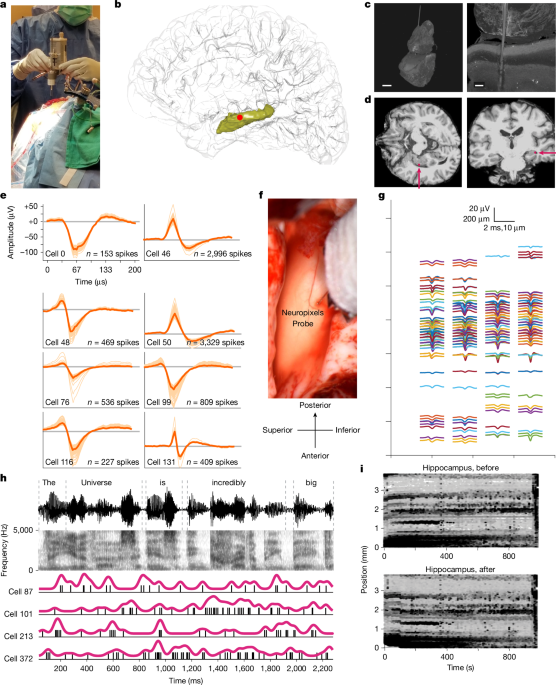
- The study employed advanced recording techniques with Neuropixels probes during surgery, rigorous data processing, and natural language processing tools to analyze word embeddings, surprisal, and linguistic features, demonstrating robust linguistic encoding in the unconscious brain.
- These findings suggest that the hippocampus contributes to high-level language processing even under anesthesia, revealing access to abstract semantic relationships and contextualization critical for speech comprehension, with implications for understanding language representation in the brain.


