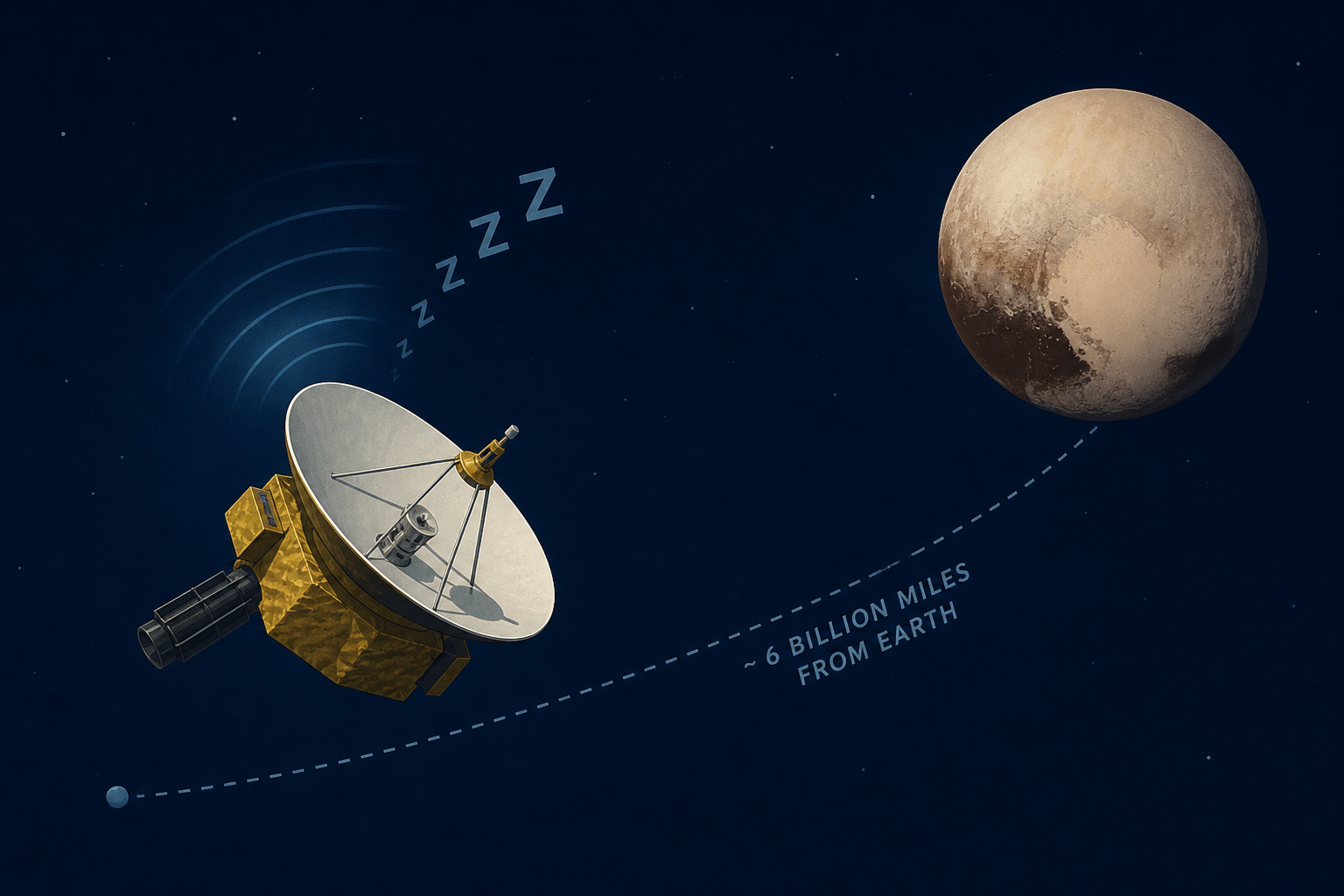
AI Generated Image
Pluto flyby mission wakes up after long sleep nearly 6 billion miles from Earth
Yahoo • • science
Key Points:
- NASA's New Horizons spacecraft has awakened from its longest hibernation since August 2025, now located 5.9 billion miles from Earth in the Kuiper Belt, ready to transmit new scientific data.
- The mission continues to study trans-Neptunian objects (TNOs) like Pluto and Arrokoth, providing insights into the formation of planets and the characteristics of distant icy bodies in the solar system.
- Instruments aboard New Horizons are measuring rotation rates of Kuiper Belt objects, the distribution of gas in the outer heliosphere, galactic cosmic rays, and unexpected dust levels beyond the known Kuiper Belt boundary.
- The spacecraft has undergone over 20 hibernations since 2007 to conserve resources and extend its lifespan, with the current mission set to conclude in 2029 but potentially continuing if the spacecraft remains healthy.
- If extended, New Horizons could eventually leave the heliosphere and enter interstellar space, following a trajectory similar to the Voyager probes, further expanding our understanding of the solar system’s outer limits.


