AI Image
Prehistoric whale reveals extreme skull asymmetry
Phys.org • • science
Key Points:
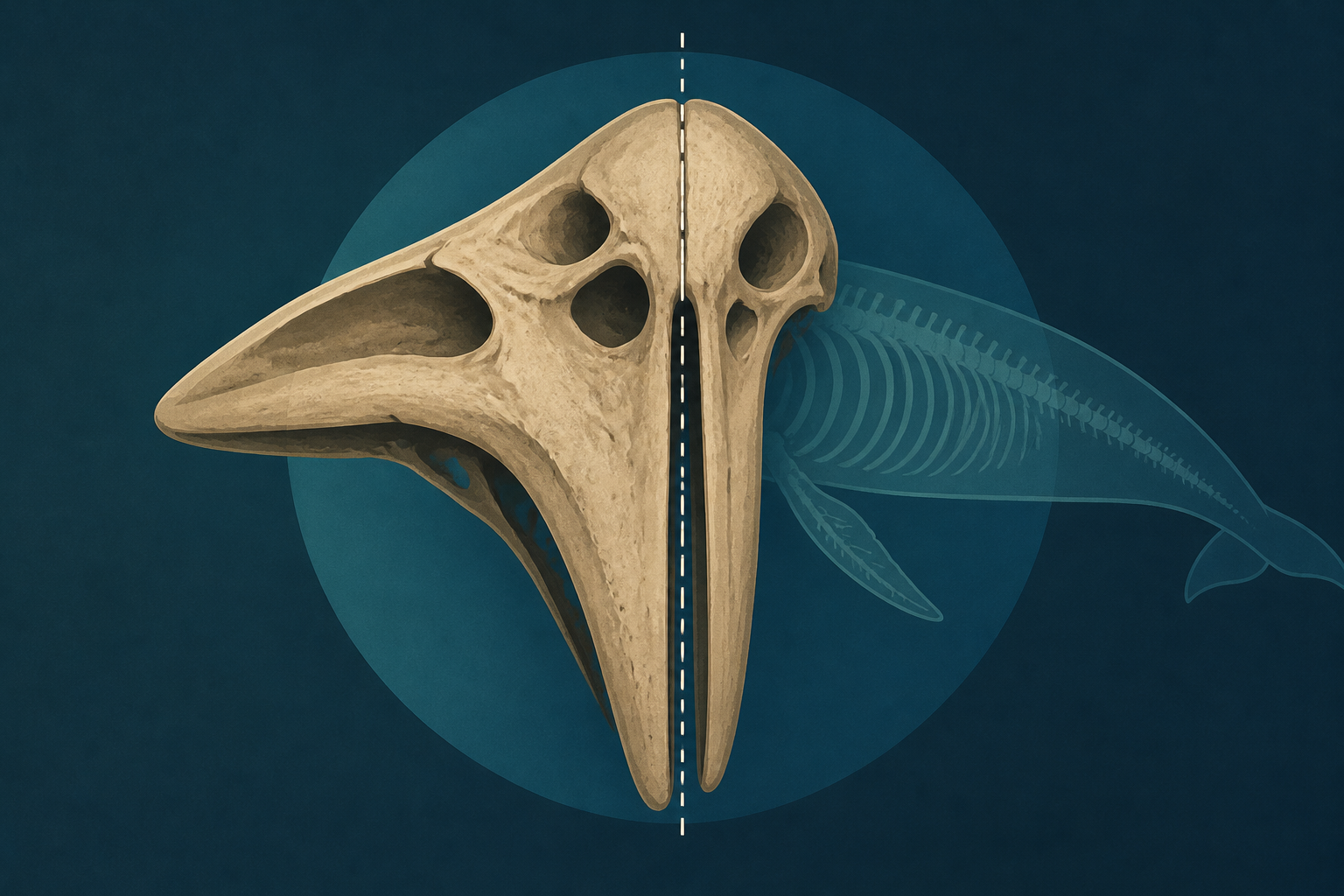
- Researchers have identified a new extinct species of pygmy sperm whale, Scaphokogia huachafo, from the Late Miocene period (6.3 to 5.6 million years ago), notable for having the most extreme facial asymmetry recorded in any cetacean or possibly any mammal.
- The skull of Scaphokogia huachafo, about 2.7 meters long, shows both bony nostrils shifted entirely to the left and dramatically uneven facial bones, resulting in a highly crooked appearance linked to specialized sound production organs.
- The species name "huachafo" reflects its bizarre and extravagant skull anatomy, a term from Peruvian Spanish describing something flashy or over-the-top, highlighting the whale's unusual and asymmetrical features.
- Unlike modern sperm whales that hunt squid in deep waters, Scaphokogia huachafo was adapted for bottom-feeding in shallow coastal environments, with a downward-curving snout and flexible neck allowing it to forage close to the seabed.
- The whale likely used its asymmetrical biosonar system to detect prey in soft sediments, occupying a specialized ecological niche that disappeared after the Miocene as oceanic conditions and marine mammal ecosystems evolved.


