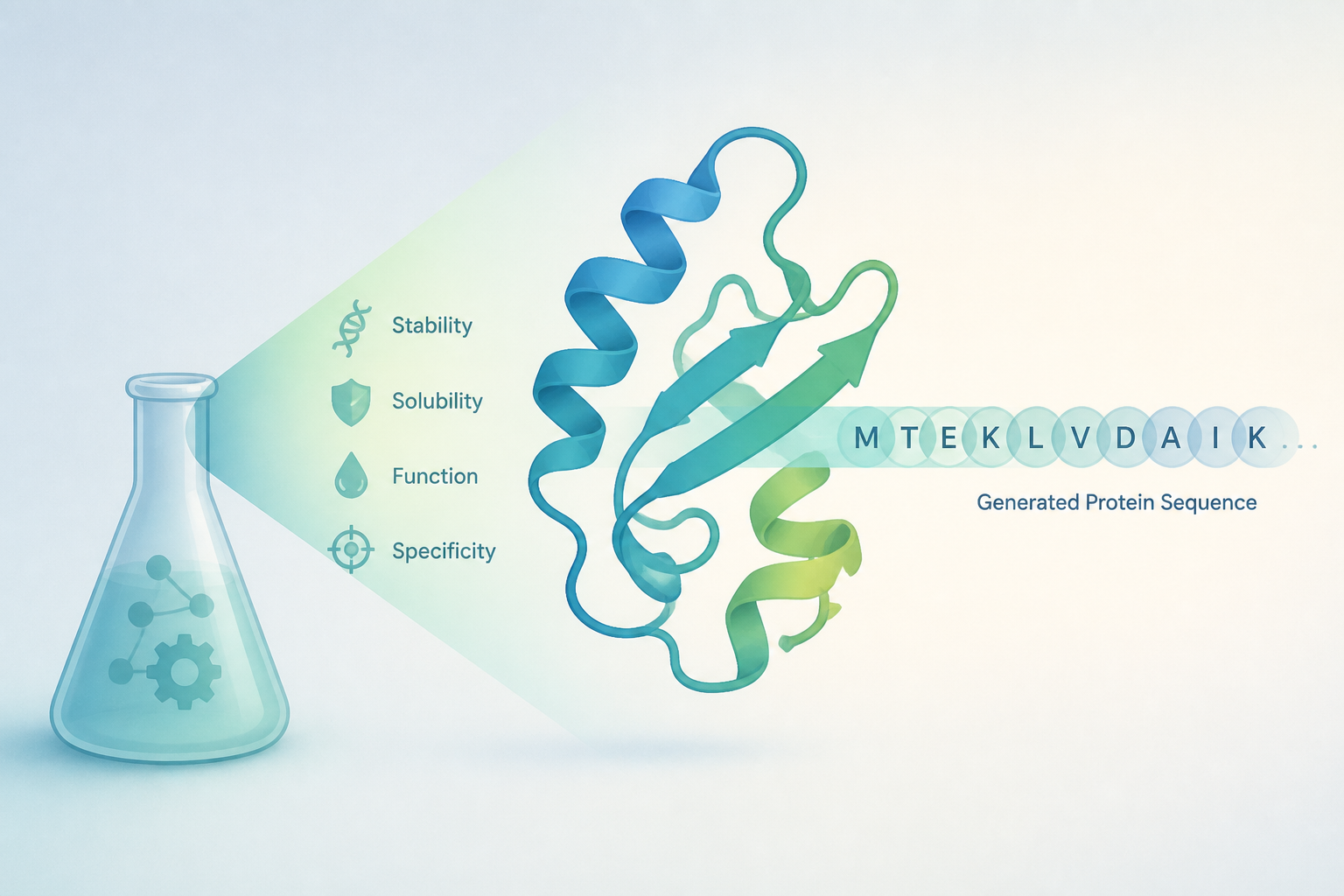
AI Generated Image
Property guidance for protein sequence generative models with ProteinGuide
Nature • • science
Key Points:
- Recent advances in protein design leverage deep learning and generative models, including ProteinMPNN, RFdiffusion, and RoseTTAFold sequence space diffusion, to create functional and multistate proteins with atomic accuracy.
- Protein language models and diffusion-based generative techniques have been enhanced through reinforcement learning and direct preference optimization to align generated sequences with experimental fitness and human preferences, improving design outcomes.
- Discrete diffusion models and masked language modeling approaches are increasingly applied to protein and enzyme design, enabling efficient and controllable generation of protein sequences conditioned on target functions or structures.
- Large-scale experimental analyses, such as deep mutational scanning and evolutionary-scale predictions, provide critical datasets that inform and validate machine learning models for protein folding stability and function prediction.
- Advances in base editing and enzyme engineering, supported by computational tools and machine learning, are expanding the capabilities for precise genome and transcriptome modifications, with applications in biotechnology and therapeutic development.


