Punctuated decline of human cooperation
Nature • • health
Key Points:
- A five-year field study of group lending in Sierra Leone reveals that human cooperation, even under favorable conditions, is dynamic and prone to decline due to behavioral mechanisms rather than strategic learning or financial ability.
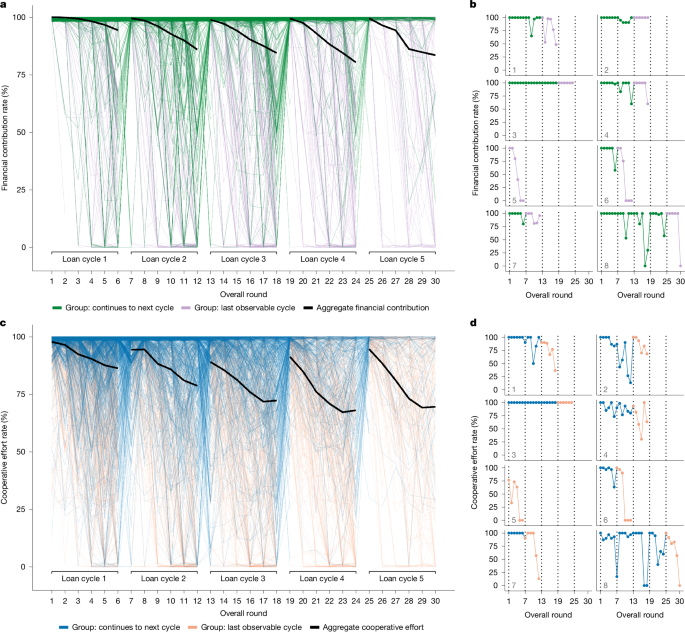
- The study analyzes 47,931 group-level payments from 1,589 groups and 7,108 members, complemented by 73 in-depth interviews, showing cooperation rates fluctuate with sharp rebounds after loan restarts but generally exhibit a punctuated decline over time.
- Behavioral changes such as members becoming ‘lethargic,’ ‘relaxed,’ or ‘tired of paying’ lead to partial free-riding and collective inefficiency, undermining long-term cooperation even in stable group structures with strong social enforcement mechanisms.
- Qualitative data indicate diverse motivations for cooperation, widespread distributional conflict, and heterogeneous defection patterns, including intermittent free-riding and occasional full collapse of cooperation within groups.
- The findings highlight that minor behavioral cues, like loan restarts, can temporarily revitalize cooperation, but their effects diminish over time as groups habituate, accelerating the decline in cooperative effort despite stable social dilemma conditions.


