AI Image
Quantum sensor could measure how Earth drags spacetime
Phys.org • • general
Key Points:
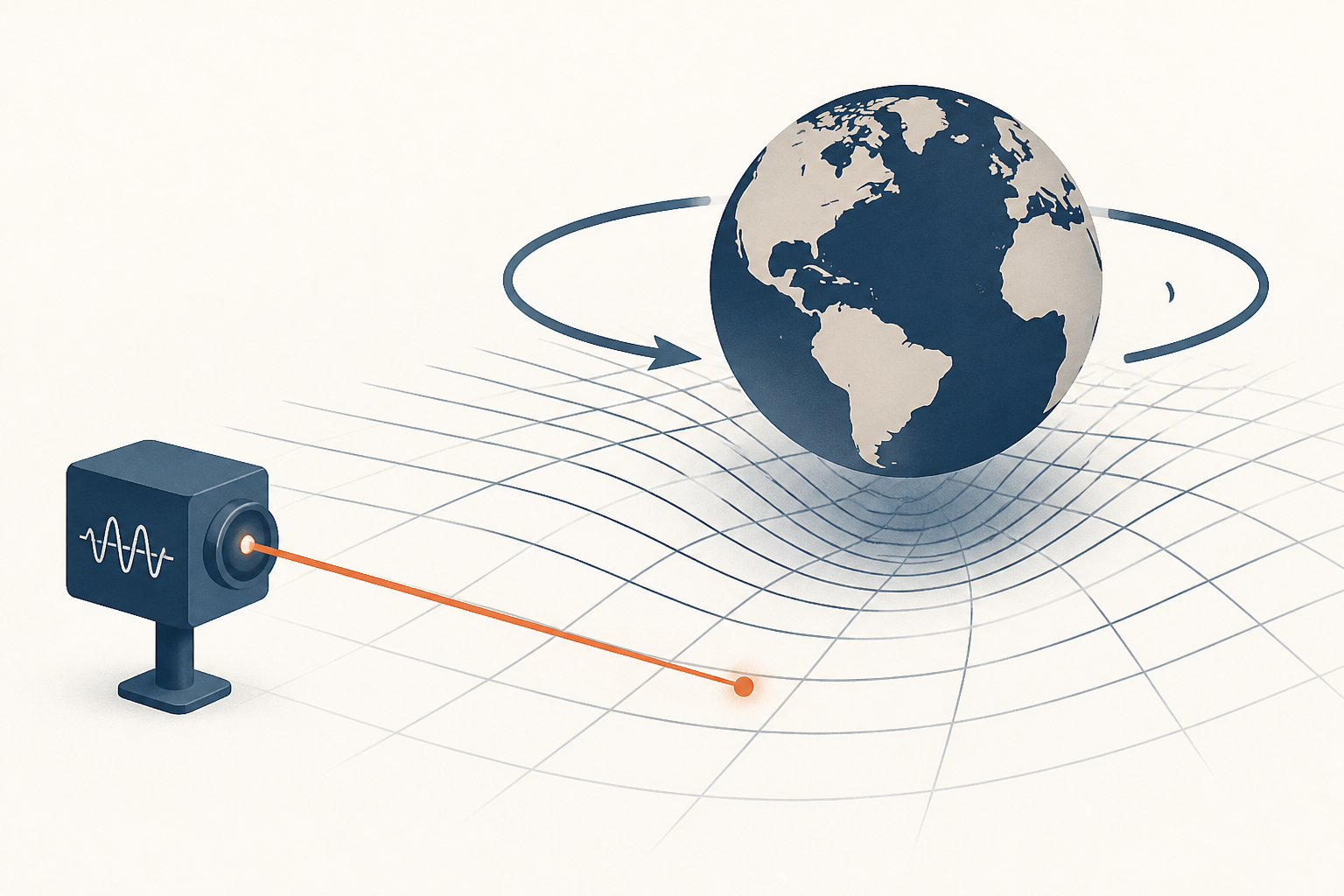
- Researchers from UC Berkeley, the Austrian Academy of Sciences, and Caltech propose a quantum sensor using superfluid helium-4 in a gyrometer to measure the tiny frame-dragging effect predicted by Einstein's general relativity in a laboratory setting.
- The sensor exploits the superfluid state of helium cooled below 2.17 K, detecting rotation-induced quantum phase differences across a Josephson junction, potentially allowing precise measurement of Earth's spacetime dragging effect.
- Cooling the superfluid gyrometer to millikelvin temperatures could significantly reduce thermal noise, enabling sensitivity that matches or surpasses current frame-dragging measurements typically requiring space-based experiments.
- The proposed device could also detect minute variations in time passage around the sensor loop, offering a novel method to test gravitational effects on time and explore physics near the Planck time scale, relevant to quantum gravity theories.
- Experimental realization requires development of Josephson junctions operable at ultra-low temperatures, with ongoing work at Caltech, while theoretical studies aim to explore potential new physics beyond Einsteinian gravity accessible through this technology.


