AI Generated Image
Rhythm and timing in laughter reveal that human vocal plasticity falls on a hominid continuum
Nature • • science
Key Points:
- Laughter is a conserved vocalization across all extant great apes and humans, occurring primarily during social play and affiliative interactions, serving to signal benign intent and maintain social coordination.
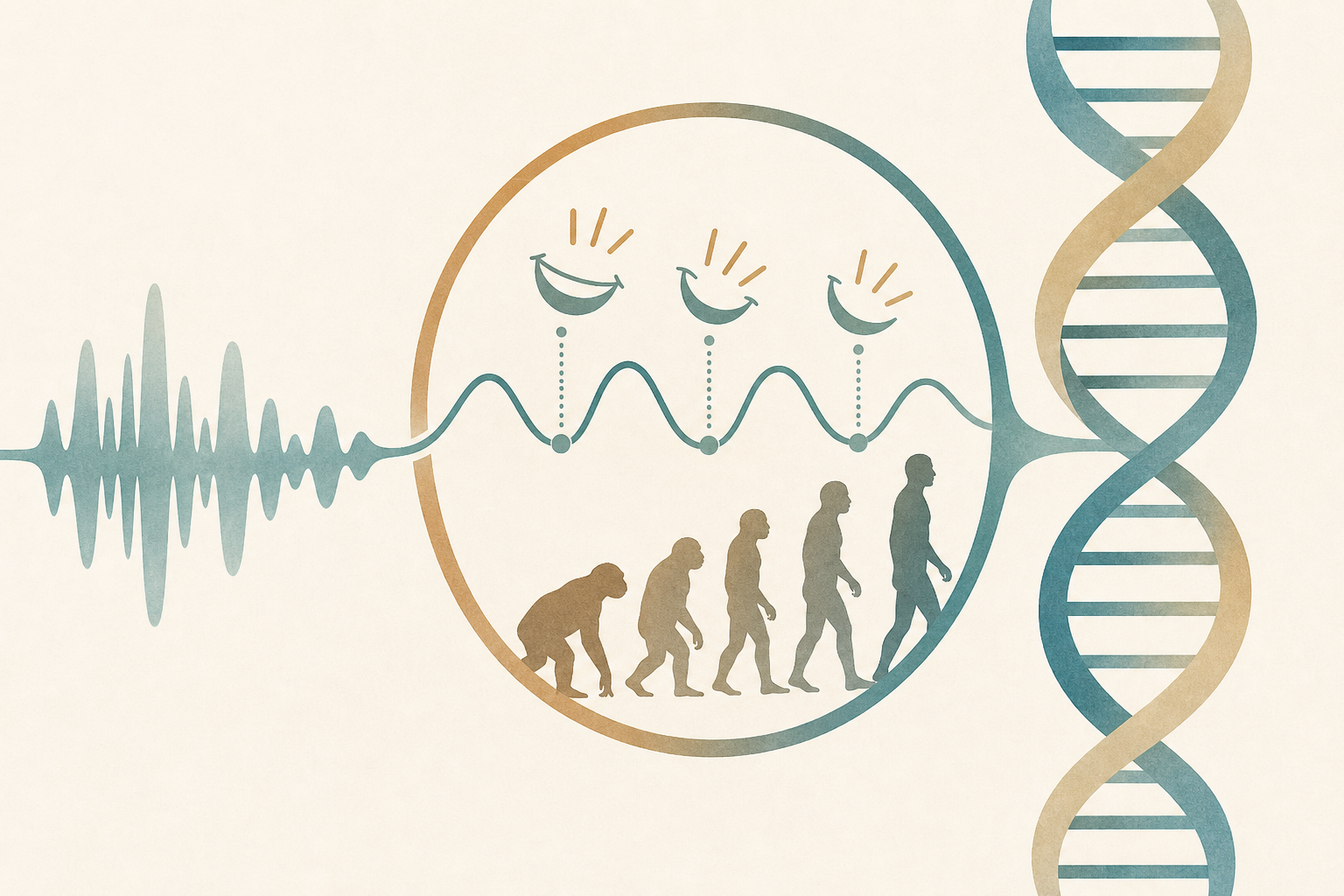
- A comparative analysis of laughter rhythms across orangutans, gorillas, bonobos, chimpanzees, and humans reveals that laughter is isochronous (regularly timed) in all species, with tickling laughter showing higher temporal regularity than play laughter.
- Evolutionarily, laughter tempo has accelerated along the hominid phylogenetic tree, with humans exhibiting faster, more variable, and context-sensitive laughter rhythms, indicating enhanced vocal control and rhythmic flexibility.
- The study suggests that increased temporal variability and context-dependent modulation in human laughter reflect advanced vocal motor control, which may have paved the way for the emergence of speech and language.
- These findings provide empirical evidence for the evolutionary refinement of vocal control in hominids and position laughter as a valuable model for understanding the deep evolutionary roots of human vocal communication.


