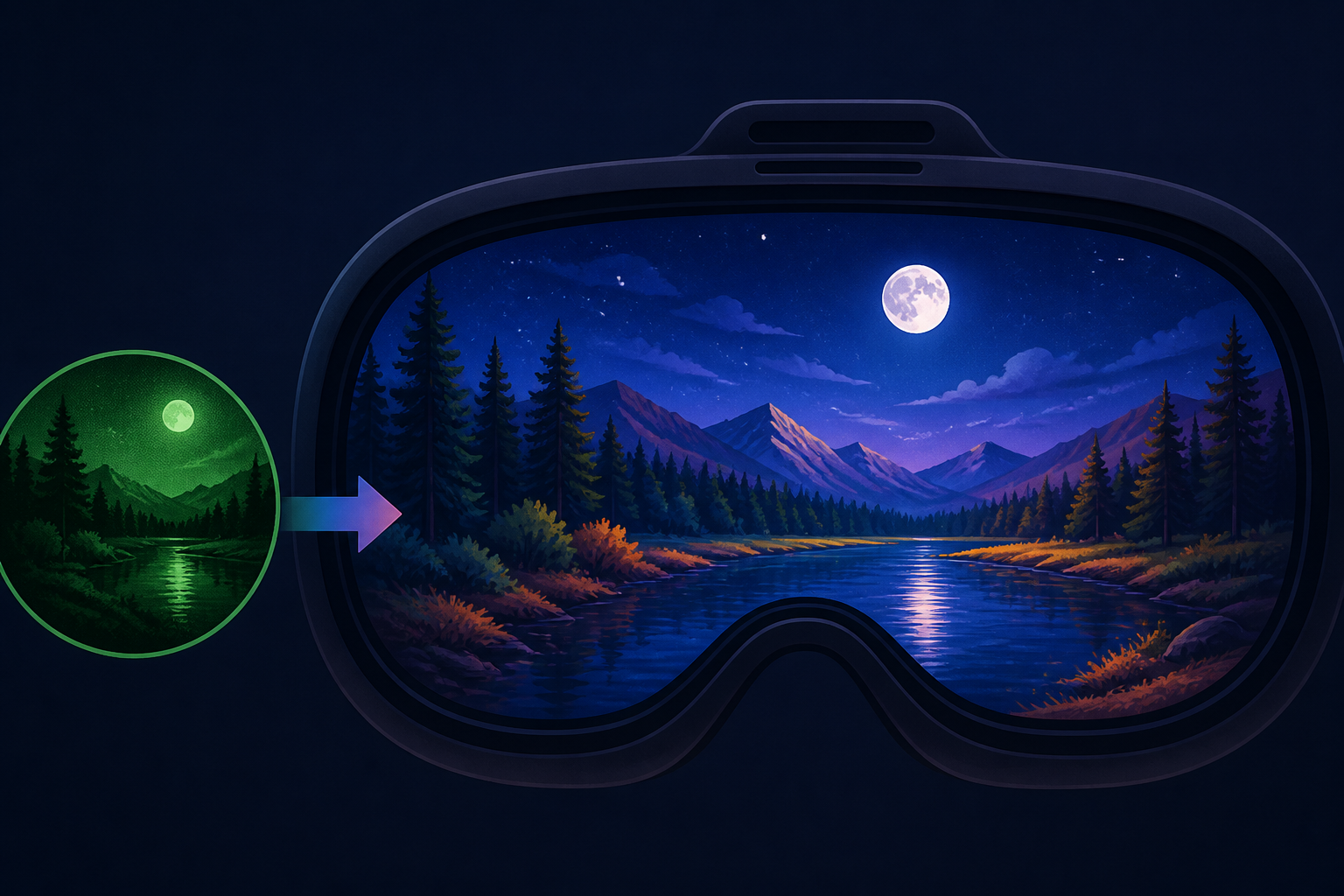
AI Generated Image
Scientists built night vision that shows full color instead of just green
TechSpot • • technology
Key Points:
- Researchers at the Beijing Institute of Technology have developed a prototype device that converts infrared light into full-color images using mercury telluride quantum dots and a dual-layer OLED, moving beyond traditional monochrome night vision displays.
- The device maps different infrared wavelengths and intensities to distinct visible colors by leveraging the quantum dots' discrete energy states and a two-layer OLED that emits red and cyan light, enabling richer information capture than conventional brightness-based systems.
- A lightweight, semi-transparent eyeglass prototype weighing 23 grams demonstrated clear, color-coded infrared images and can operate in modes overlaying infrared on normal vision or filtering visible light for immersive viewing.
- Biological tests showed that infrared signals processed through the device elicited responses in engineered cells, mice brains, and human retinas, suggesting potential applications in visual prosthetics.
- Limitations include testing only in controlled environments with simple targets, the need for external power for the OLED, and safety concerns related to the use of mercury telluride, a heavy-metal compound.


