AI Generated Image
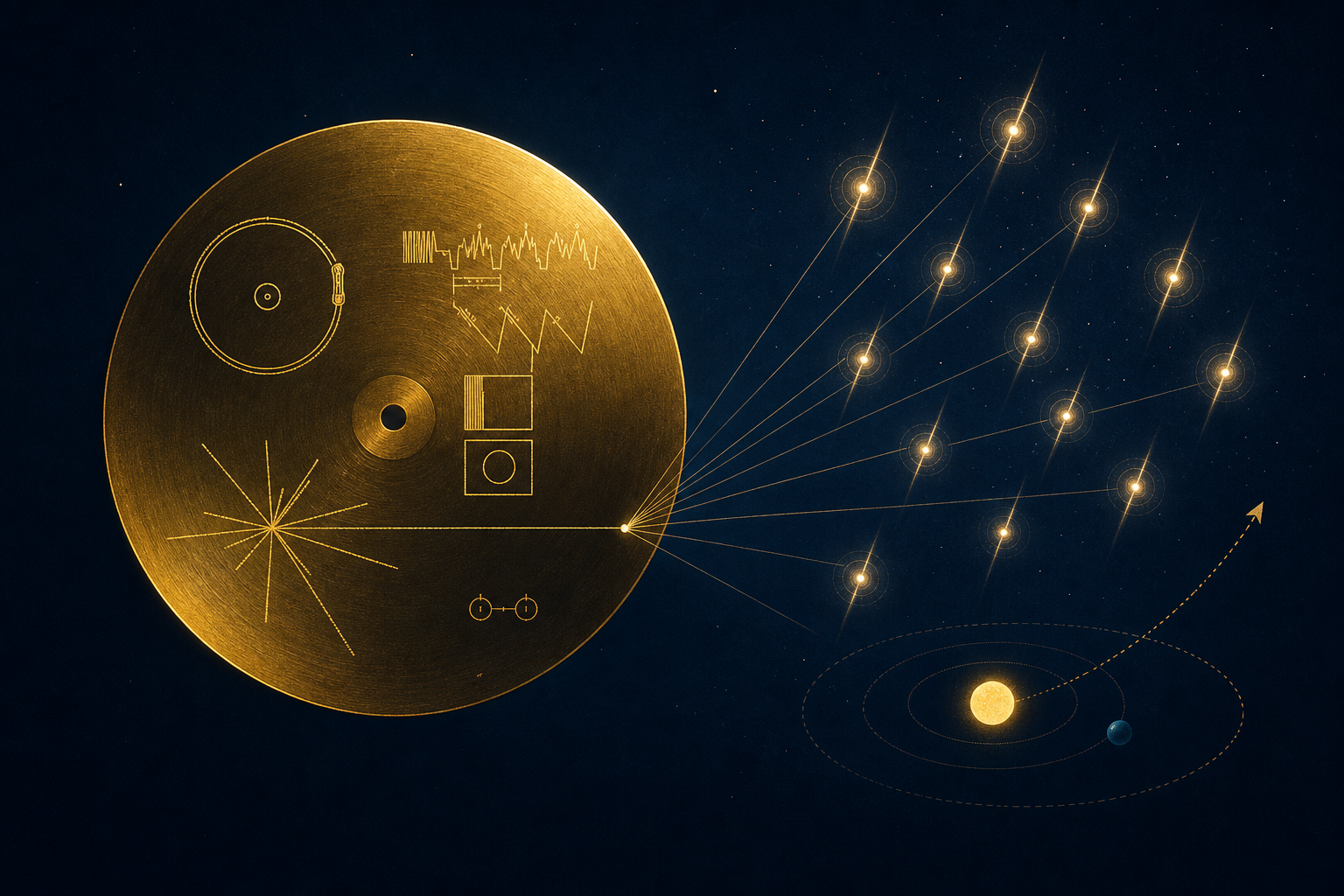
The lines etched into Voyager’s Golden Record cover point towards 14 pulsars whose spinning clocks reveal both where the Sun is and roughly when the spacecraft left — directions designed to work witho
Space Daily • • technology
Key Points:
- Voyager’s Golden Record cover features a starburst diagram with 14 rays pointing to pulsars, encoding their rotation periods in binary to indicate the Sun’s location and provide a rough launch date, independent of human language.
- The pulsar map concept was originally created by Frank Drake for the Pioneer 10 and 11 plaques and later reused on Voyager's Golden Record cover, which also includes instructions on how to play the record and decode its contents.
- Pulsars act as cosmic clocks with stable rotation periods that slowly lengthen over time, allowing a finder to estimate when the message was sent by comparing current pulsar data to the encoded periods.
- The map relies on universal physical constants, such as the hyperfine transition of neutral hydrogen, to define time units, but its symbolic binary notation and graphical representation still assume a certain interpretive framework.
- While the map locates the Solar System, it does not specify Earth or any particular location within it, and the message’s recovery depends on an advanced civilization capable of understanding astrophysics and decoding the complex scientific clues.


