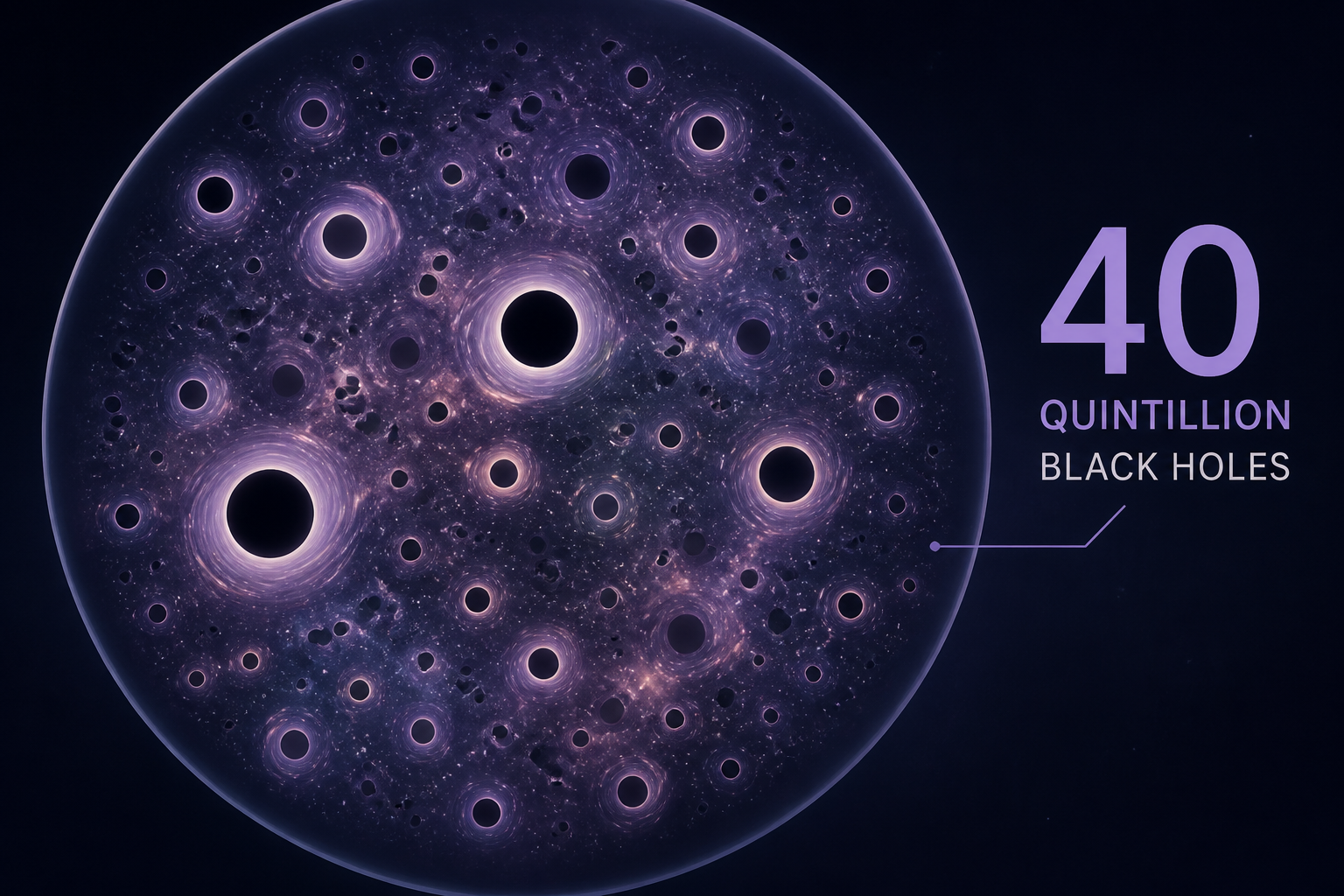
AI Generated Image
The universe may contain a staggering 40 quintillion black holes
The Brighter Side of News • • science
Key Points:
- Astronomers estimate there are about 40 quintillion (40 billion billion) stellar-mass black holes in the observable universe, collectively containing nearly 1% of all ordinary (baryonic) matter.
- The estimate was derived by modeling stellar and binary evolution alongside galaxy formation and metal enrichment across cosmic history, rather than direct observation.
- Most stellar black holes range between 5 and 50 solar masses, with the heaviest ones linked to interactions in dense star clusters, which help explain black hole mergers detected via gravitational waves.
- The study suggests that stellar black holes present in the early universe could serve as "light seeds" for the growth of larger black holes, potentially leading to supermassive black holes observed at high redshifts.
- These findings connect stellar evolution, galaxy history, gravitational wave observations, and black hole formation, highlighting that black holes are far more common than previously understood.


