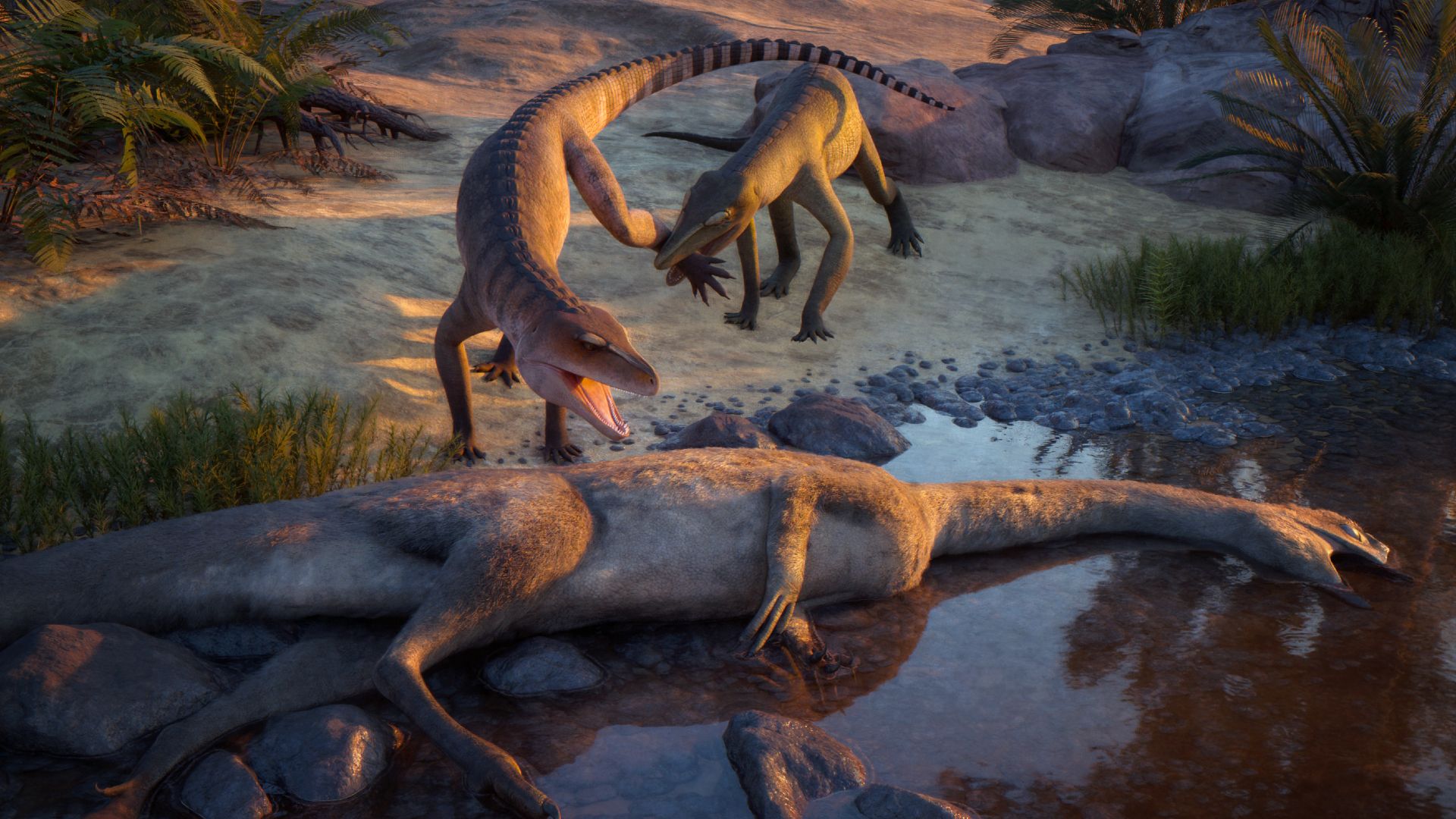
Triassic croc relative from Ghost Ranch, New Mexico finally identified after nearly 80 years in museum basement
Live Science • • general
Key Points:
- A newly identified Triassic-era relative of modern crocodiles, named Eosphorosuchus lacrimosa, hunted on land rather than in water, resembling predators like foxes or jackals.
- The fossil, discovered in 1948 at Ghost Ranch, New Mexico, was reclassified from Hesperosuchus agilis to a new genus and species due to its distinct short snout and reinforced skull, indicating a powerful bite.
- Eosphorosuchus lacrimosa and H. agilis coexisted in the same environment around 205 million years ago but likely occupied different ecological niches, with E. lacrimosa possibly preying on larger, less agile animals.
- The discovery provides rare evidence of early crocodylomorph diversity and functional differences, shedding light on the early evolutionary stages of crocodile relatives, which are poorly represented in the fossil record.
- Researchers emphasize that each new fossil find significantly alters the understanding of crocodylomorph evolution, highlighting the importance of continued fossil discoveries and analysis.


