AI Generated Image
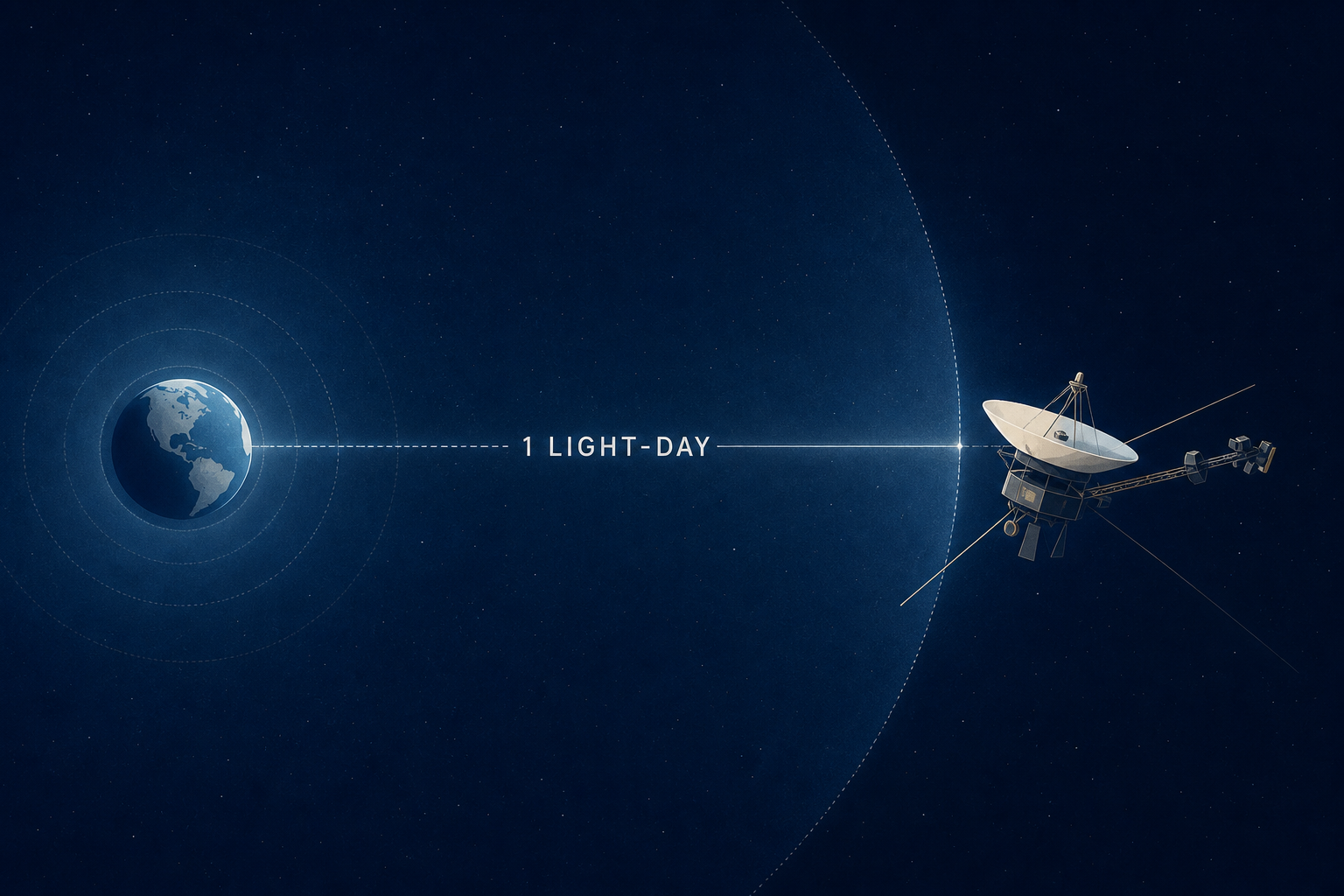
Voyager 1 launched in 1977 on a four-year mission, and in November 2026, nearly half a century later, it will become the first object ever to reach one light-day from Earth — so distant that a signal
19FortyFive • • science
Key Points:
- In November 2026, NASA’s Voyager 1 spacecraft will reach a distance of one light-day from Earth, meaning signals sent from it will take 24 hours to arrive home, marking a significant milestone in space exploration.
- Launched in 1977, Voyager 1 is the most distant human-made object, now nearly 26 billion kilometers from Earth and traveling at about 38,000 miles per hour toward the constellation Ophiuchus.
- Despite technical challenges, including a 2023 computer glitch, NASA engineers have maintained communication with Voyager 1, allowing it to continue sending valuable scientific data from interstellar space.
- Originally designed to study the outer planets using gravitational assists, Voyager 1 revolutionized our understanding of Jupiter and Saturn and their moons during flybys in the late 1970s and early 1980s.
- Since crossing into interstellar space in 2012, Voyager 1 has provided unprecedented data on magnetic fields, charged particles, and plasma waves, enhancing knowledge of the Solar System’s interaction with the galaxy.


