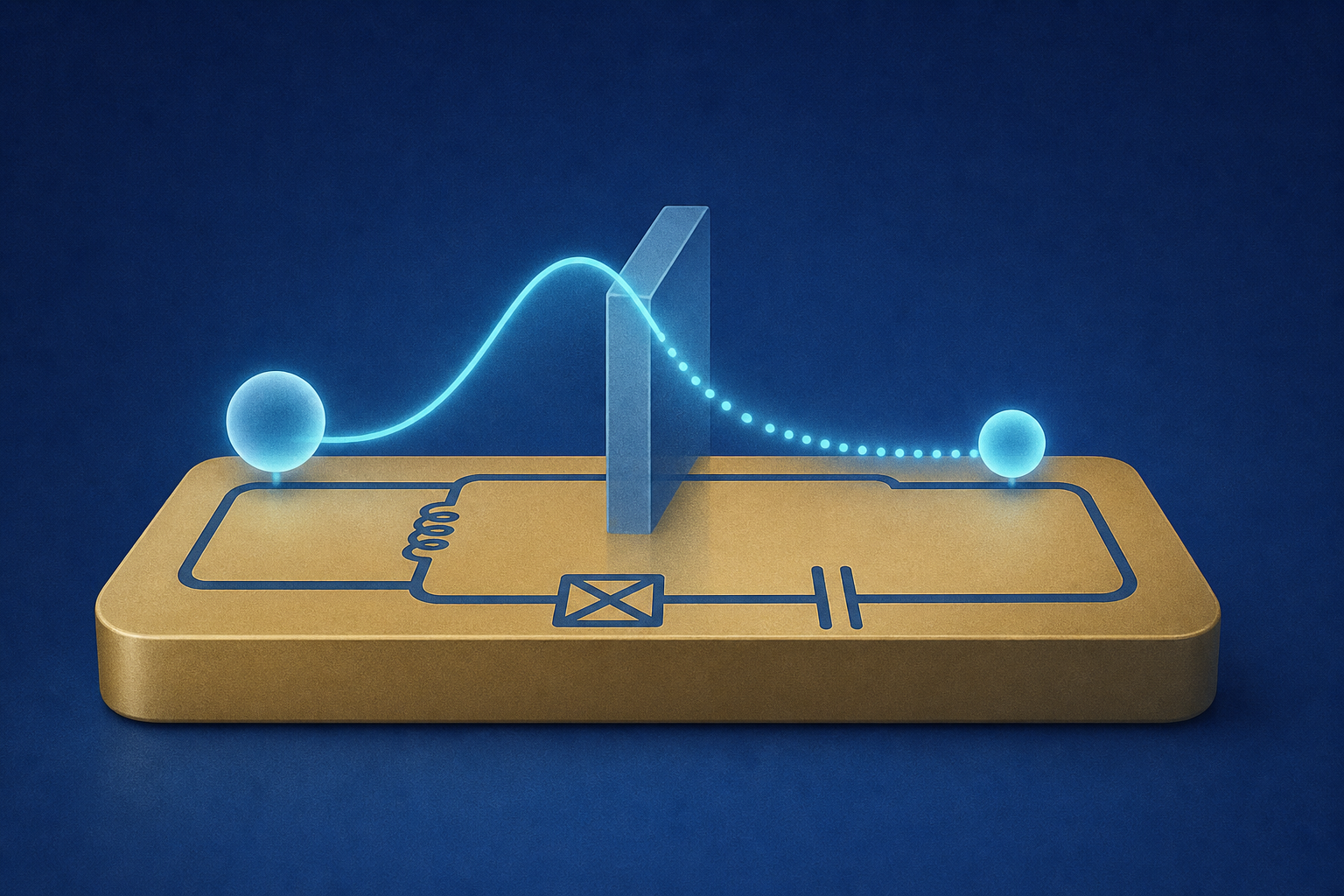
AI Generated Image
We tend to think quantum tunnelling is a subatomic curiosity, but in 1984 and 1985 physicists at UC Berkeley showed that a superconducting electrical circuit big enough to hold in your hand could tunn
Space Daily • • science
Key Points:
- The 2025 Nobel Prize in Physics was awarded to John Clarke, Michel H. Devoret, and John M. Martinis for discovering macroscopic quantum tunnelling and energy quantisation in superconducting electrical circuits, demonstrating quantum effects on a scale large enough to be held in the hand.
- Their 1984-1985 experiments at UC Berkeley showed that a collective electrical state in a superconducting circuit, involving billions of paired electrons, could tunnel through an energy barrier, a phenomenon previously observed only in microscopic particles.
- The team used a Josephson junction cooled to extremely low temperatures to measure how the system escaped a zero-voltage state via quantum tunnelling, distinguishing this effect from classical thermal or noise-induced transitions through repeated precise measurements.
- They also demonstrated energy quantisation in the circuit by applying microwaves and observing discrete energy level transitions, confirming that the macroscopic system exhibited quantum behavior similar to atoms.
- This foundational work legitimised the concept that engineered electrical circuits could display quantum mechanics, paving the way for developments in superconducting qubits and quantum computing technologies.


