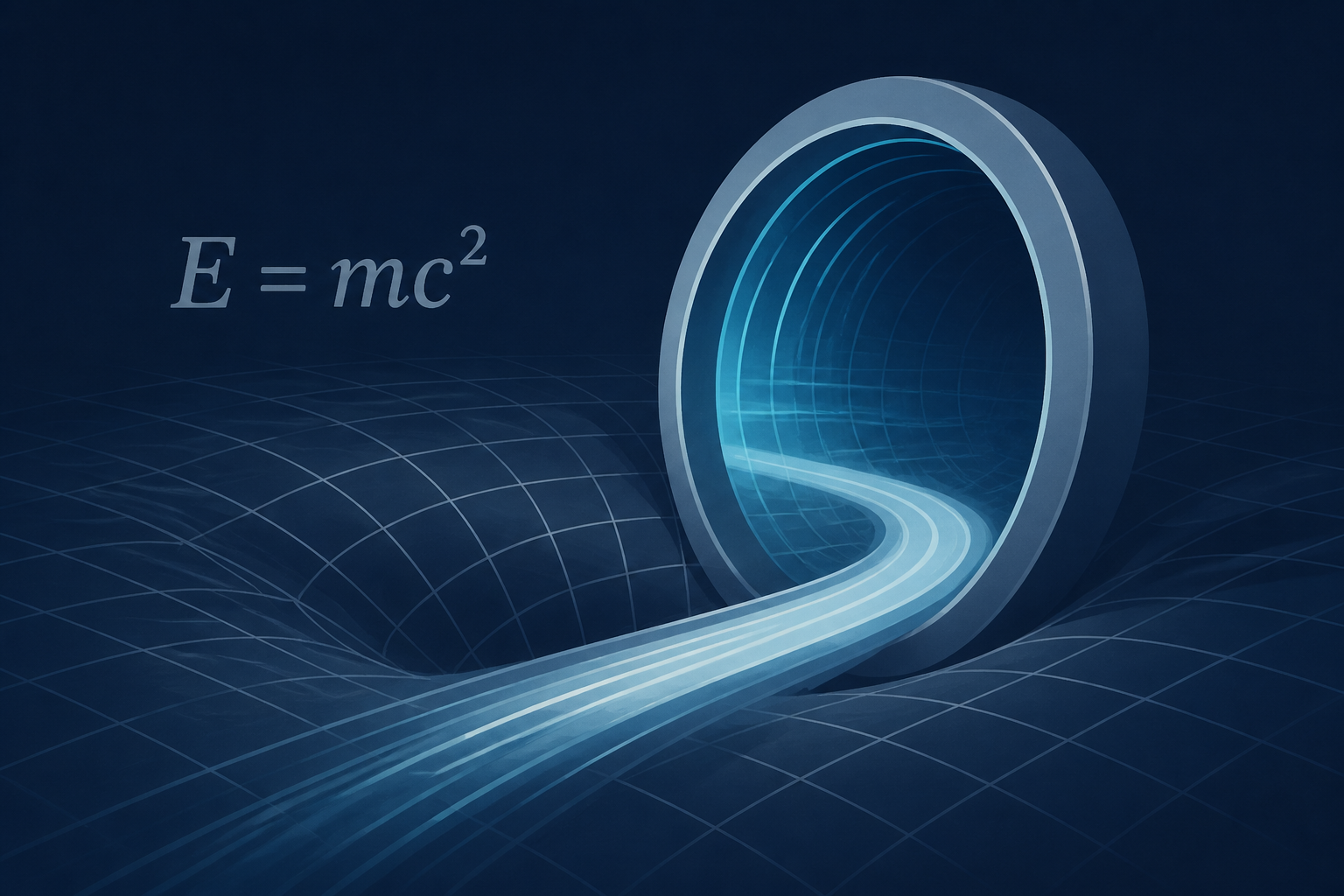
AI Generated Image
Why Einstein's theories of relativity make time travel possible
Yahoo • • science
Key Points:
- Einstein's theories of special and general relativity revolutionized our understanding of time, showing that time and space are flexible and can be stretched or compressed depending on conditions such as velocity and gravity.
- Time travel to the future is theoretically possible through rapid movement at speeds close to the speed of light or by experiencing strong gravitational fields, as demonstrated by phenomena like time dilation observed in astronauts and near black holes.
- General relativity's equations allow for the theoretical possibility of backward time travel via closed timelike curves, first identified by mathematician Willem Jacob van Stockum in 1937, though such solutions are highly complex and depend on specific spacetime geometries.
- Solutions to Einstein's field equations, such as Karl Schwarzschild's for stationary masses and Roy Kerr's for rotating masses, reveal different spacetime structures; notably, Kerr's solution permits closed timelike curves but only in unstable regions near rotating black holes.
- Despite these theoretical possibilities, practical backward time travel remains speculative due to the instability of the required spacetime regions, and ongoing research continues to explore different models and their implications for the nature of the universe and time.


