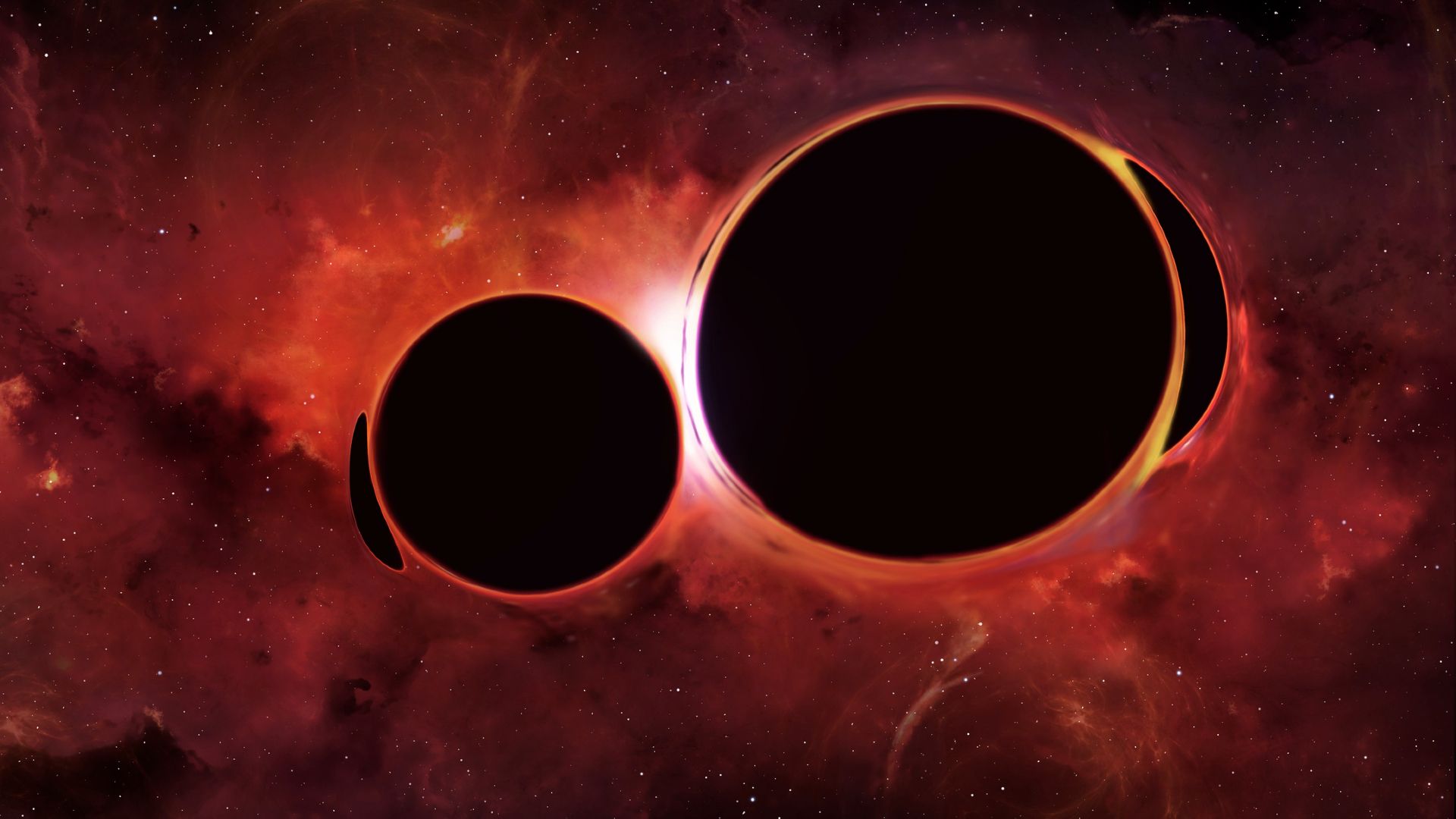
2 supermassive black holes may collide 100 years from now — and Earth would feel it
Live Science • • general
Key Points:
- Astronomers have identified a pair of supermassive black holes in the galaxy Markarian 501, spiraling toward a collision possibly occurring within the next century, based on decades of radio telescope data.
- The object, previously classified as a blazar, was found to emit two distinct jets of energy, each powered by a black hole weighing between 100 million and a billion solar masses, rather than a single jet from one black hole.
- In June 2022, gravitational lensing created an Einstein ring from the light of the secondary jet, providing compelling evidence for the binary black hole system.
- The two black holes orbit each other approximately every 121 days at a distance of 250 to 540 times the Earth-Sun distance, gradually closing in for an eventual merger.
- Scientists anticipate that the collision will produce powerful gravitational waves potentially detectable by Earth-based observatories, offering valuable insights into black hole physics.


