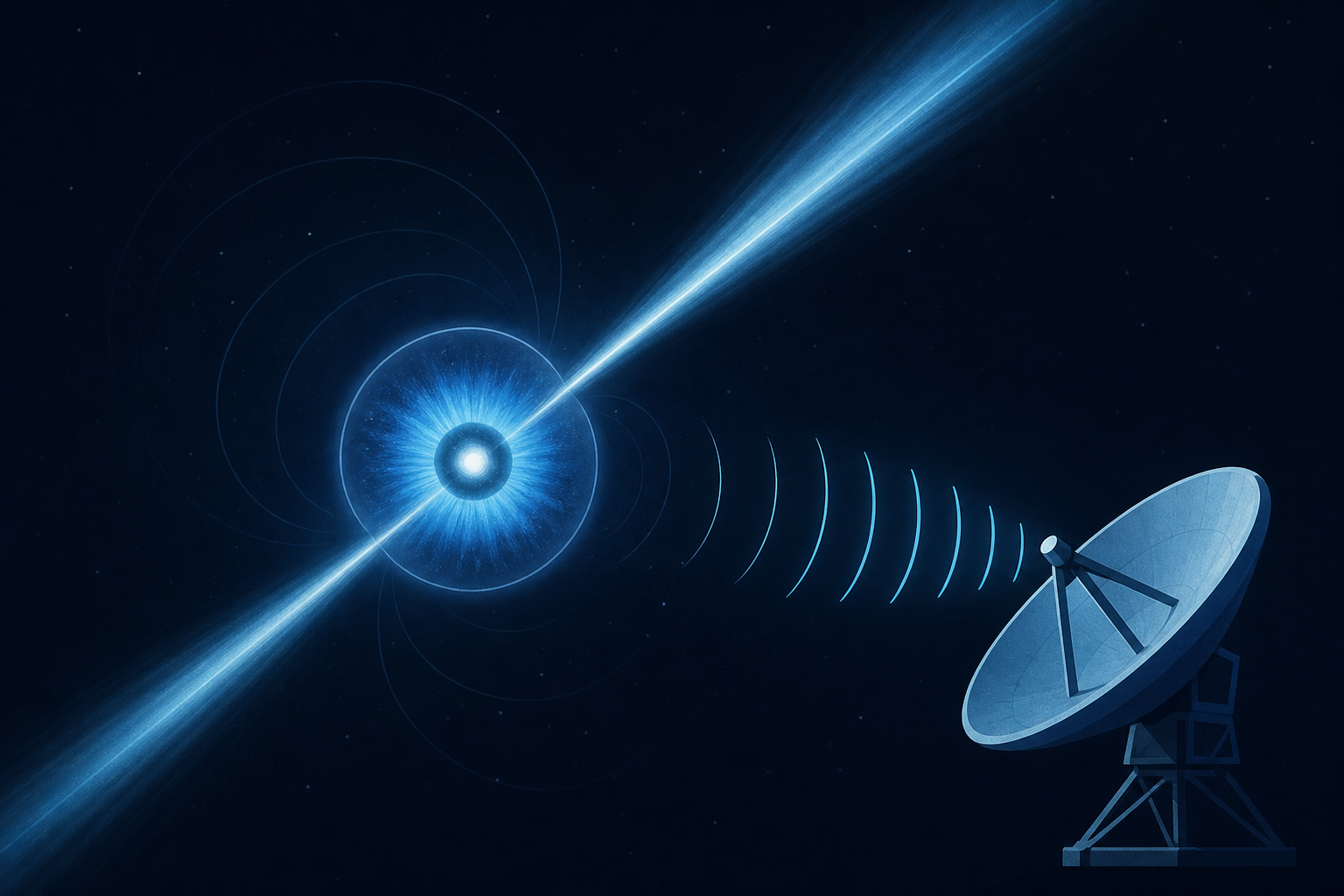
AI Generated Image
Astronomers discover radio signals coming from rare 'Blue Eye Pulsar' after decades of silence
Yahoo • • science
Key Points:
- Astronomers have detected faint radio emissions from a previously silent neutron star, known as 1E 1207.4-5209 or the "Blue Eye Pulsar," located at the center of a supernova remnant 10,000 light years away in the Milky Way.
- This discovery challenges the notion that some neutron stars, called central compact objects (CCOs), are radio silent due to weak magnetic fields, suggesting they may emit very faint radio pulses instead.
- The Blue Eye Pulsar experienced a "spin glitch" in 2015, which likely altered its magnetic field and triggered or enhanced its faint radio emissions, implying such glitches could reveal hidden pulsars.
- Continued monitoring of the Blue Eye Pulsar could determine if its radio emissions switch off as its rotation slows, indicating a potentially large population of faint pulsars that have gone undetected in our galaxy.
- This finding may also help explain why some supernova remnants, like that of supernova 1987A, appear to lack detectable pulsars despite evidence suggesting a neutron star is present.


