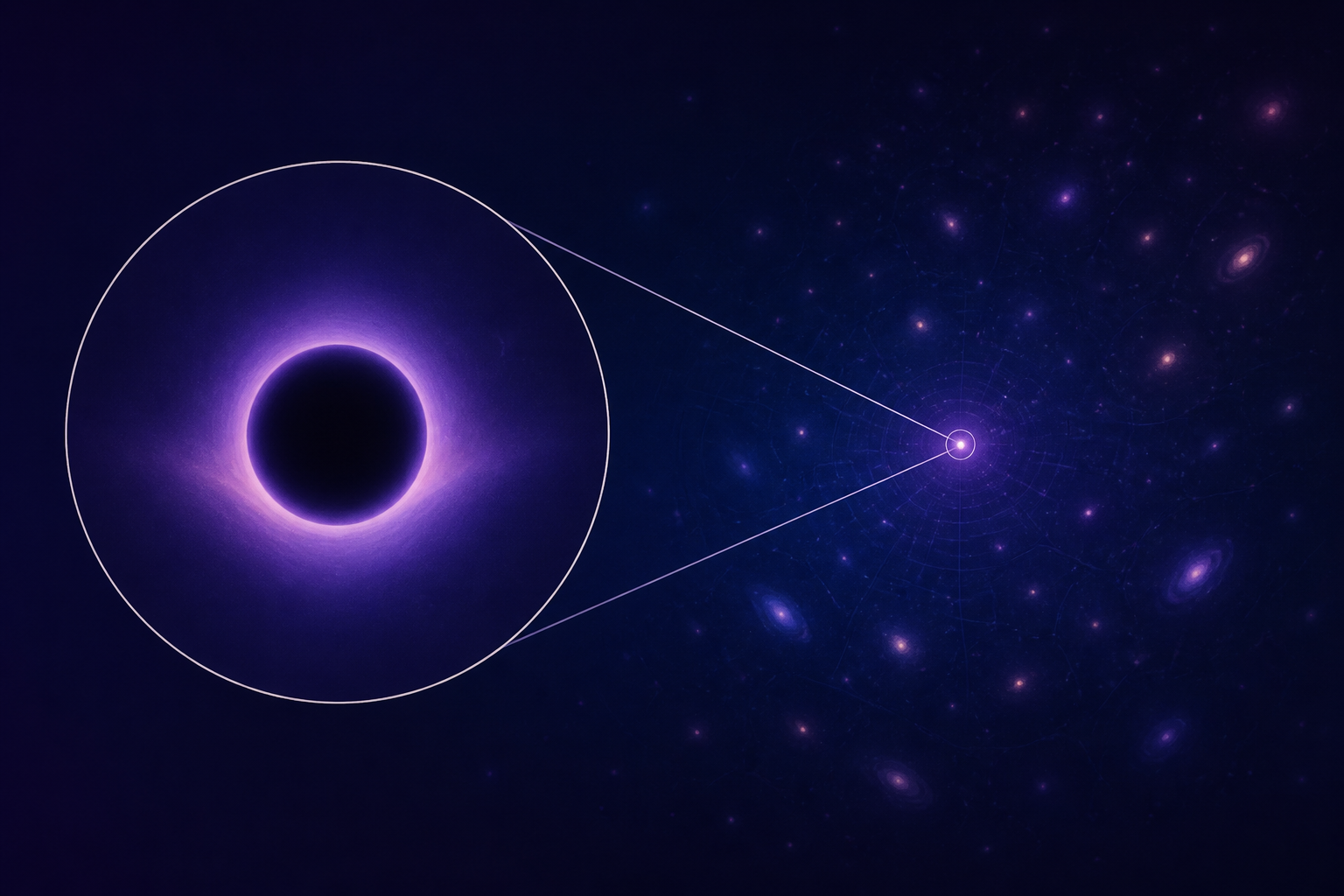
AI Generated Image
Black hole star? Solar-system-size 'dot' from the early universe is our best evidence yet of a brand-new type of cosmic object
Live Science • • science
Key Points:
- Astronomers have identified MoM-BH*-1, the most promising candidate for a "black hole star," a hypothetical dense gas ball superheated by a giant black hole, detected by JWST about 660 million years after the Big Bang.
- MoM-BH*-1 is significantly brighter than typical stars, lacks heavy metals, and exhibits a unique electromagnetic spectrum with a deep Balmer break, suggesting it is surrounded by a dense hydrogen-helium gas shell rather than dust.
- The black hole within MoM-BH*-1 is estimated to weigh up to 100,000 solar masses, qualifying it as supermassive, and its dense gas cocoon could explain why "little red dots" (LRDs) lack detectable high-energy radiation despite their brightness.
- Researchers propose that many LRDs might be mini-galaxies hosting black hole stars at their cores, potentially formed through collisions between black hole stars and primordial stellar clusters, with MoM-BH*-1 possibly undergoing such a collision in the future.
- While MoM-BH*-1 offers strong evidence for black hole stars, further studies are required to confirm if all LRDs are related to these objects and to understand the full nature and formation of black hole stars.


