AI Generated Image
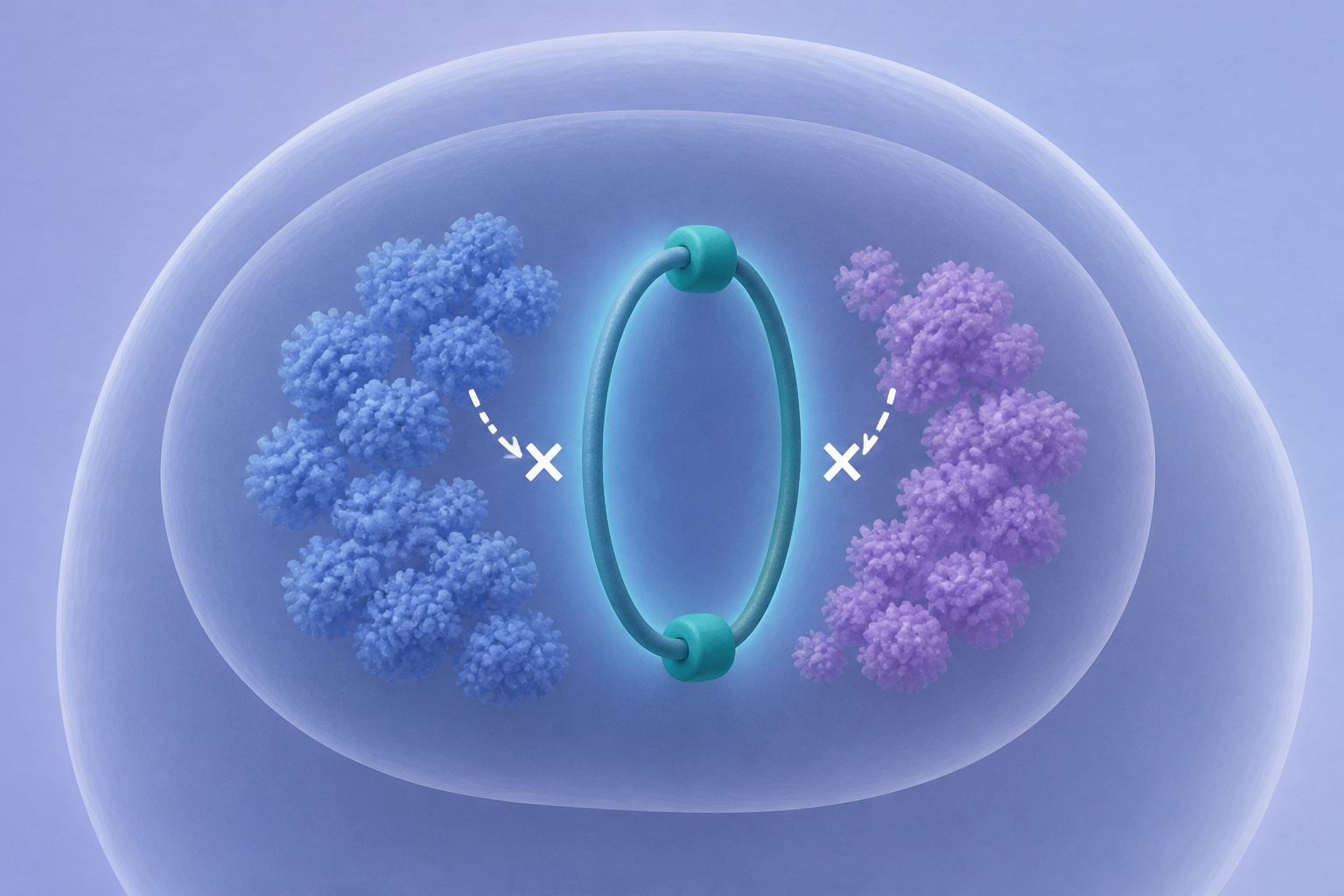
Cohesin prevents local mixing of condensed euchromatic domains in living human cells
Nature • • science
Key Points:
- Acute depletion of cohesin in human cells increases local nucleosome mobility, particularly in euchromatic regions, as shown by single-nucleosome imaging and tracking using H2B-Halo and H3.3-Halo labeling systems.
- Cohesin constrains chromatin primarily through loop formation rather than sister chromatid cohesion, with increased cohesin loops (via WAPL depletion) enhancing chromatin constraint, while CTCF depletion does not affect nucleosome motion.
- Super-resolution imaging (3D-SIM and STORM) reveals that euchromatin forms condensed domains of ~200-240 nm diameter, challenging the traditional view of euchromatin as largely open; cohesin localizes preferentially to the surfaces of these euchromatic domains.
- Despite cohesin loss increasing nucleosome mobility within euchromatic domains, overall euchromatin compaction remains largely unchanged, suggesting cohesin regulates nucleosome-level fluidity without disrupting domain condensation.
- Cohesin depletion leads to increased local mixing of chromatin domains and enhanced cis-coordination of transcriptional bursting among spatially proximal genes, indicating weakened local transcriptional insulation and a shift toward a more liquid-like chromatin state.


