AI Generated Image
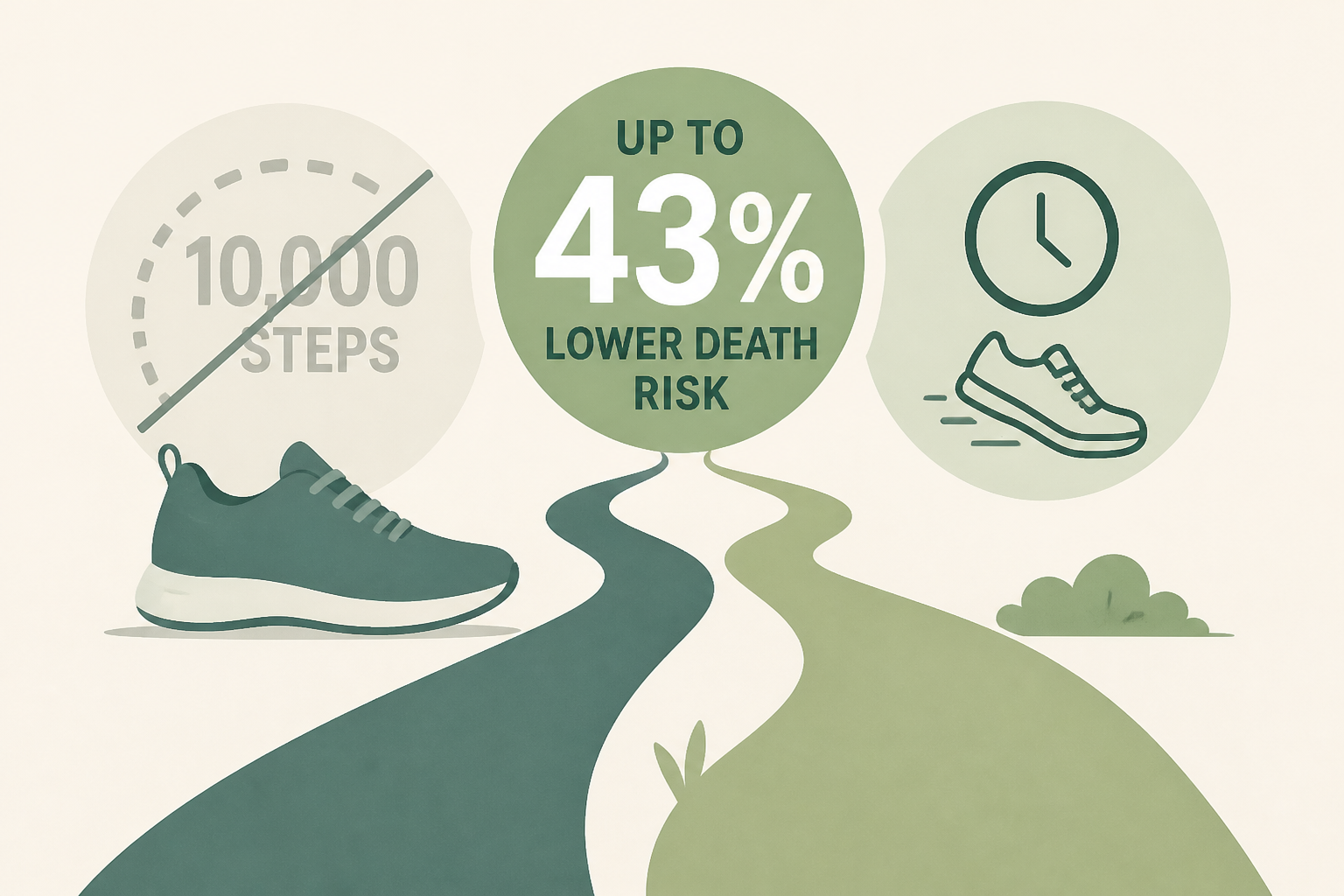
Forget 10,000 Steps. That Was Never True. These Two Easier Walking Habits Cut Your Death Risk by up to 43%
Money Talks News • • health
Key Points:
- A recent study of over 64,000 adults found that significantly lowering early death risk does not require hitting the widely promoted 10,000 steps per day; benefits were seen with fewer than 5,000 steps at a brisk pace or 5,000 to 7,500 steps at a moderate pace.
- The 10,000-step target originated from a 1960s Japanese pedometer marketing campaign and lacks a scientific basis, suggesting that arbitrary fitness goals may discourage some people or give a false sense of completion.
- Walking briskly—defined as breathing harder but still able to talk in short sentences—is highlighted as an efficient way to gain health benefits, especially for those who sit a lot, since intensity can substitute for longer duration.
- The study was observational and limited to middle-aged adults tracked for one week, so while it shows strong associations between walking habits and mortality risk, it does not prove causation.
- Practical advice includes focusing on consistent walking habits, increasing pace or distance as able, and using simple methods like the CDC’s talk test to gauge intensity, all of which can improve health without cost or special equipment.


