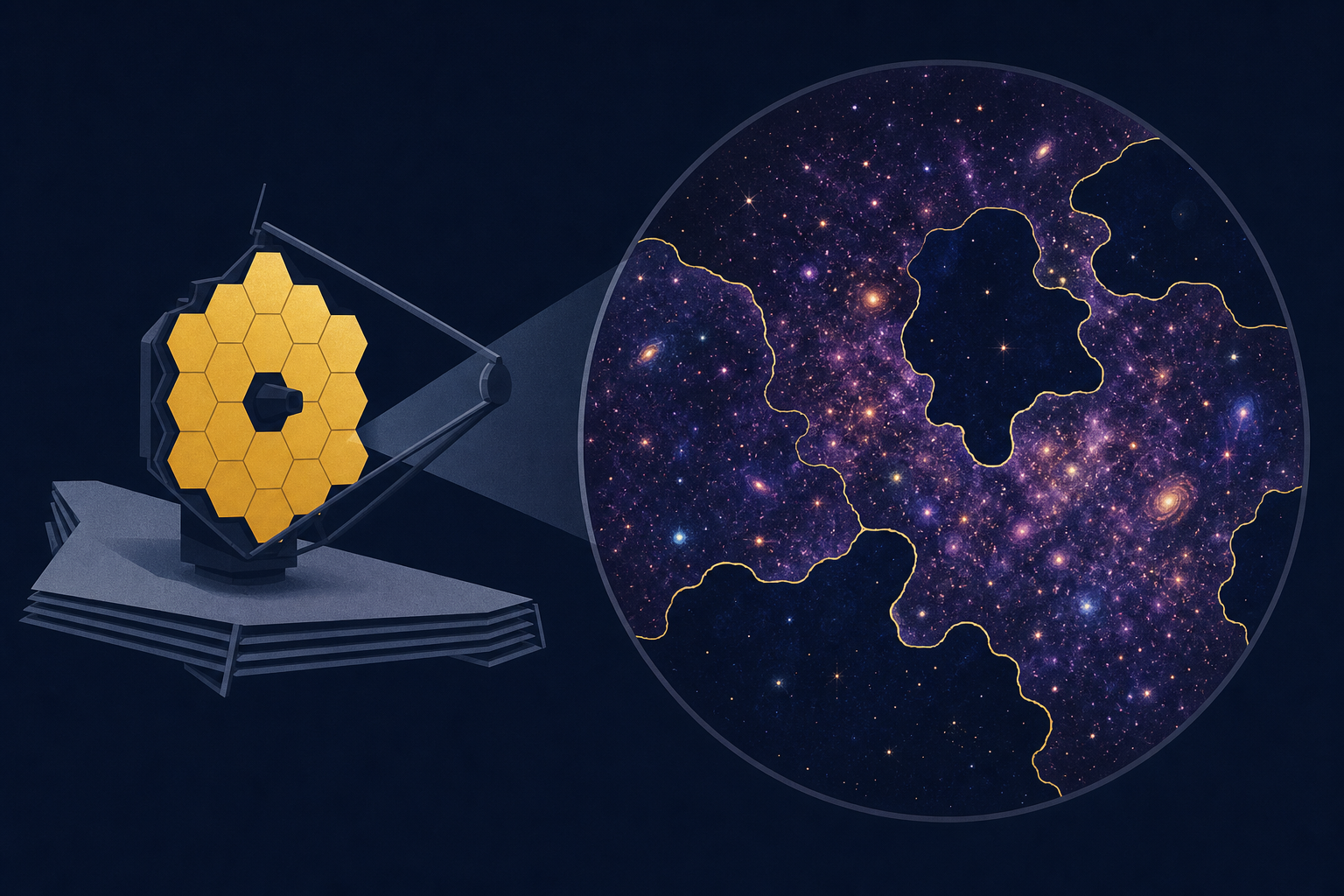
AI Generated Image
James Webb telescope's largest-ever map of the universe unmasks hidden corners
Live Science • • general
Key Points:
- Astronomers, using the James Webb Space Telescope's (JWST) largest-ever survey called COSMOS-Web, have reconstructed the cosmic web—the universe's largest structure—in unprecedented detail, revealing galaxy evolution over 13 billion years.
- The cosmic web consists of gas filaments, stars, dark matter, and voids, forming the framework of the universe and influencing galaxy growth and star formation throughout cosmic history.
- The study found that dense regions drove rapid galaxy growth in the early universe, but later became sites where star formation was quenched, largely due to massive dark matter halos and active supermassive black holes.
- Compared to previous surveys like COSMOS2020, COSMOS-Web offers better redshift precision and includes more, fainter, and more distant galaxies, allowing clearer insights into the universe's large-scale structure and evolution.
- The publicly available catalog of 164,000 galaxies from the survey enables further research, with JWST revealing the cosmic web as it appeared when the universe was only a few hundred million years old, a period previously inaccessible.


