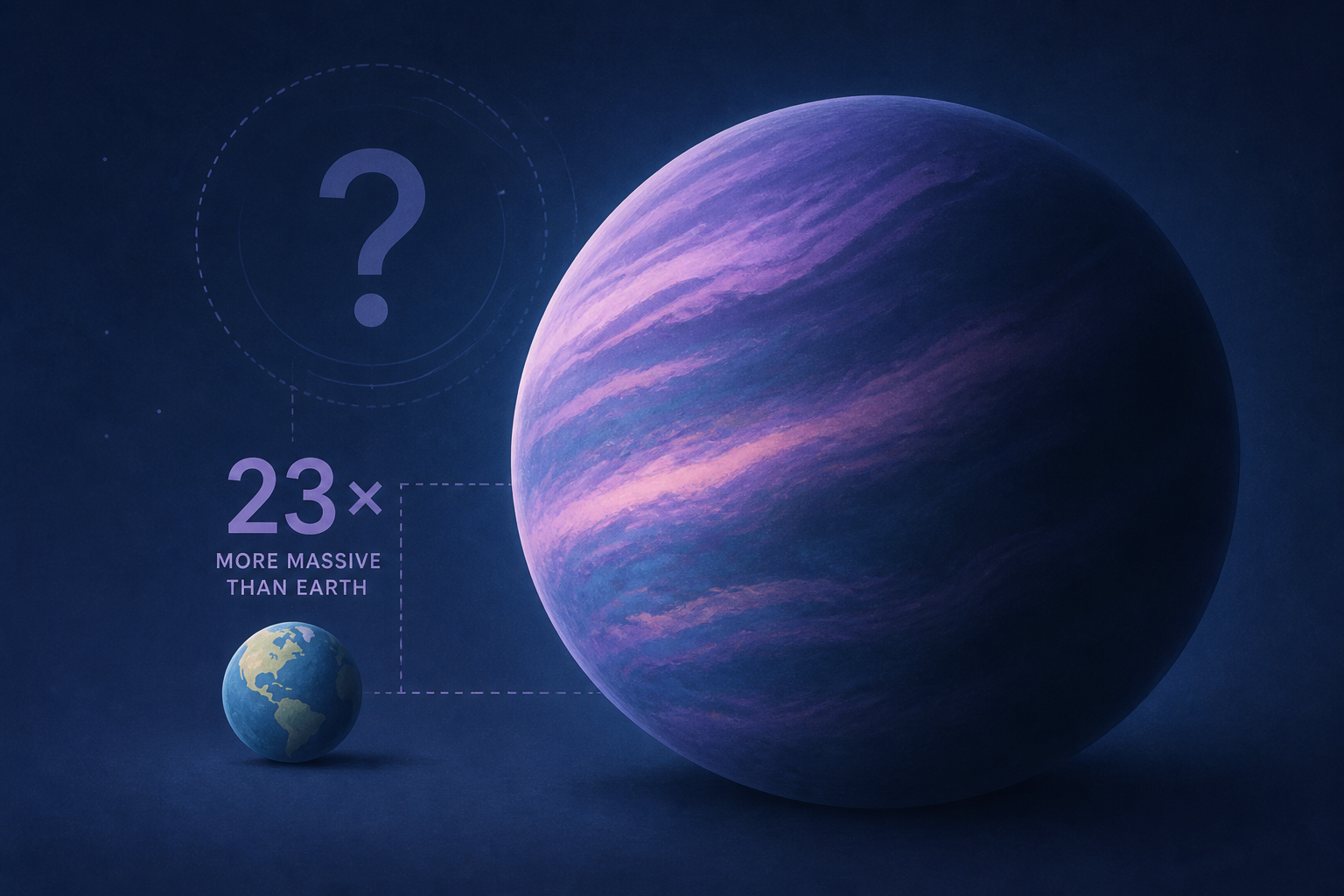
AI Generated Image
Mystery "mega-planet" 23 times more massive than Earth baffles scientists
Yahoo • • science
Key Points:
- GJ 523b is an unusually dense exoplanet over 2.5 times Earth's size and about 23 times its mass, but it has a surprisingly thin atmosphere despite its large mass.
- The planet, classified as a "Mega-Earth," challenges existing definitions of this category and could help scientists better understand massive terrestrial planets.
- Discovered initially by NASA's TESS and studied further with the WIYN telescope and James Webb Space Telescope, GJ 523b is mostly composed of dense rock surrounding a massive core.
- Researchers speculate its thin atmosphere may result from extreme heat stripping gases away, either due to a close orbit to its star or a massive collision between planets.
- Understanding GJ 523b requires interdisciplinary expertise, including geology and atmospheric science, to study its composition and atmospheric properties under extreme conditions.


