AI Generated Image
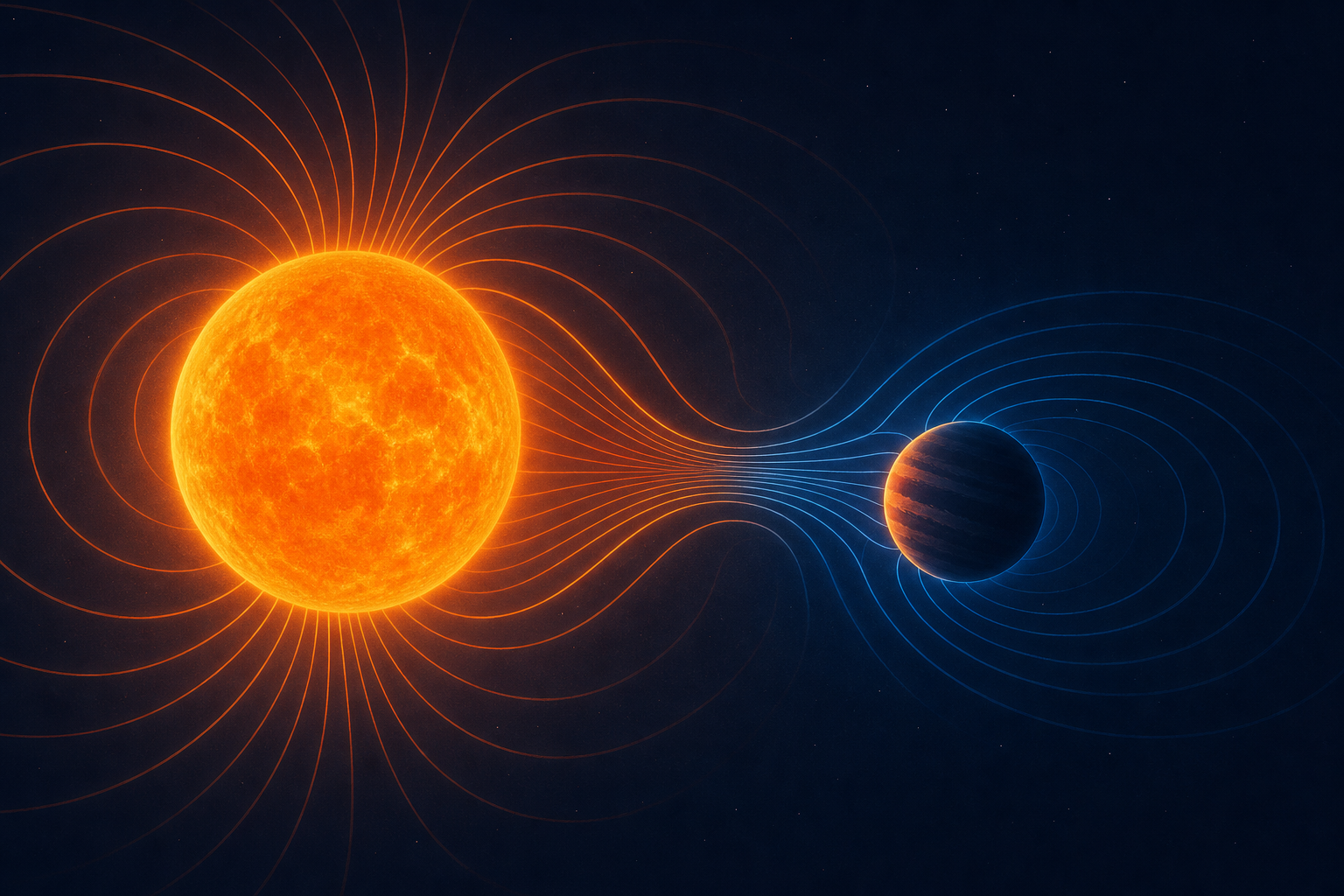
Planet orbits so close to its star that their magnetic fields connect
Ars Technica • • science
Key Points:
- Researchers have observed periodic brightening in the star GJ 436, attributed to interactions between the magnetic fields of the star and its close-orbiting exoplanet, marking a novel discovery of overlapping magnetic fields in such systems.
- GJ 436, a red dwarf about 30 light-years away, hosts a planet four times Earth's mass orbiting every 2.6 days; the team analyzed chromospheric emissions from hydrogen and calcium ions to detect magnetic activity linked to the planet's orbit.
- The periodic signal of magnetic interaction does not align exactly with the planet's orbit due to factors like the star's rotation, uneven magnetic activity distribution, and the planet's tilted magnetic axis, causing a time lag of a few hours.
- The magnetic influence signal appears intermittently, correlating with the star's activity cycle; it is strongest at intermediate activity levels and absent during high or low activity phases, suggesting stellar activity modulates the detectability of magnetic interactions.
- Modeling indicates the planet's magnetic field is at least 6 Gauss, over ten times Earth's strength and comparable to Jupiter's; this discovery opens the possibility of routinely measuring exoplanet magnetic fields in the future.


