AI Generated Image
Red dots in space: could stars 100,000 times heavier than the Sun exist?
Futura, le média qui explore le monde • • general
Key Points:
- The James Webb Space Telescope (JWST) has detected over 300 compact, bright infrared objects called Little Red Dots (LRDs), which emerged about 600 million years after the Big Bang and faded around 1.5 billion years later, exhibiting a unique combination of red and ultraviolet light.
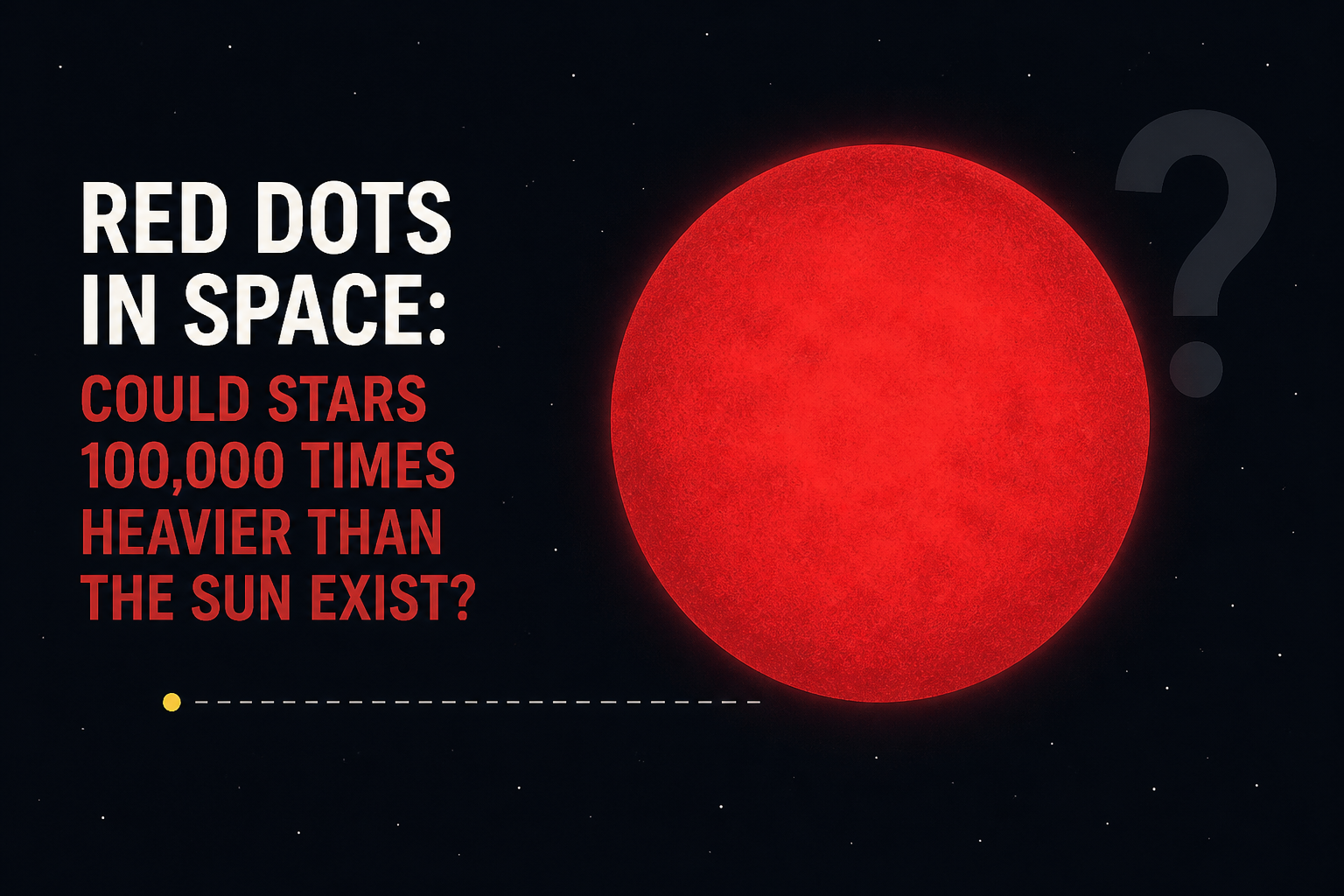
- Initial theories posited that LRDs were supermassive black holes shrouded in gas and dust, but recent research suggests they may instead be supermassive stars with masses up to 100,000 times that of the Sun, a concept long hypothesized but never observed until now.
- Astrophysicist Devesh Nandal and colleagues have developed the first model that explains many LRD features—including spectra, morphology, and chemical signatures—by proposing these supermassive stars are surrounded by thick gas envelopes that produce the observed light.
- The LRD spectra show nitrogen-rich gas ejections consistent with the predicted "strange mode" pulsations of unstable supermassive stars nearing the end of their lives, supporting the idea that these stars eventually collapse directly into the seeds of supermassive black holes.
- This discovery offers crucial insight into the early universe’s star formation and the origins of supermassive black holes, potentially solving long-standing cosmic puzzles about the formation of quasars and massive galactic centers.


