AI Image
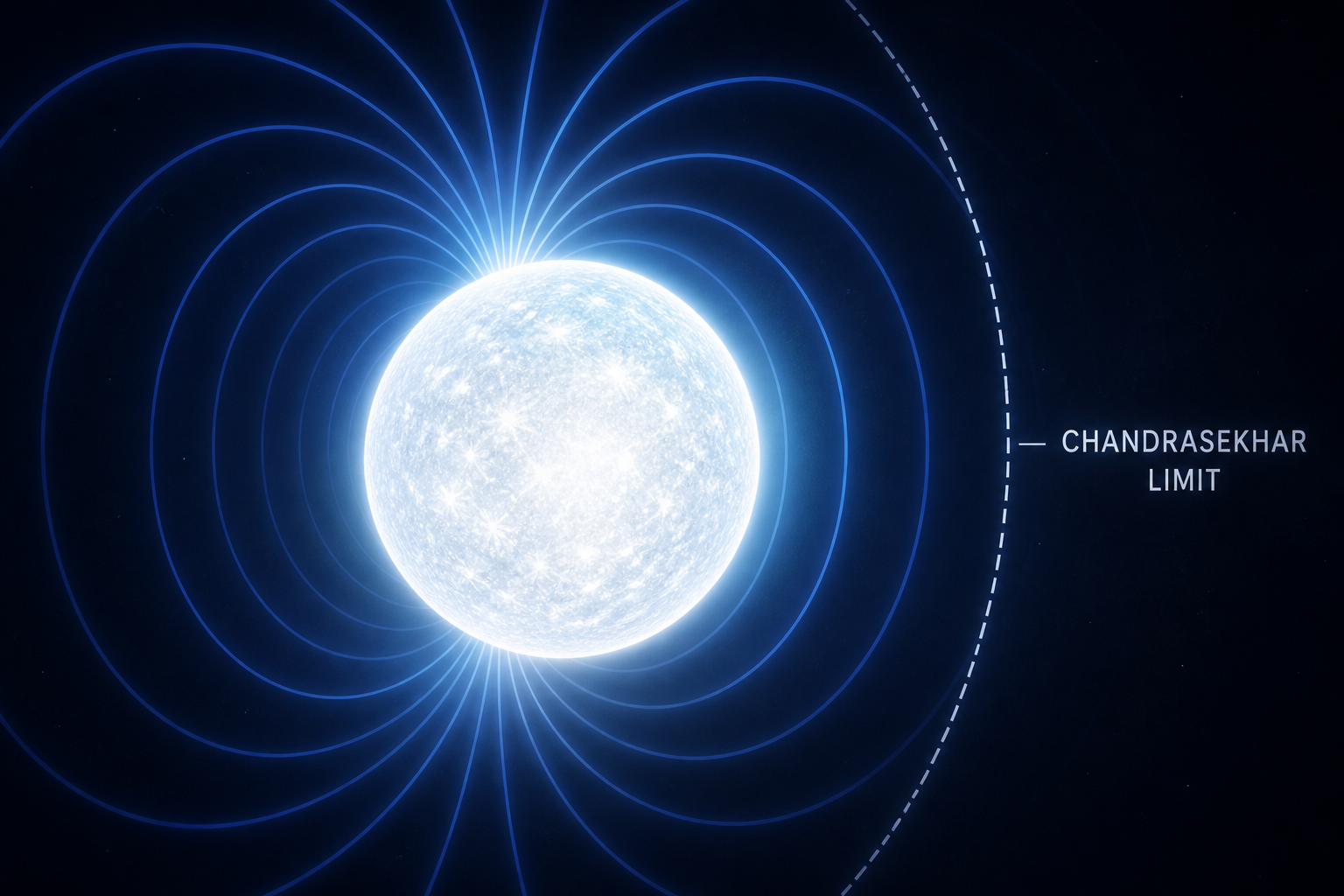
Strong magnetic fields could allow white dwarfs to grow beyond the Chandrasekhar limit
Phys.org • • science
Key Points:
- Researchers from the Indian Institute of Science (IISc) have shown through simulations that strong internal magnetic fields can allow carbon-oxygen white dwarfs to exceed the traditional Chandrasekhar limit of 1.4 solar masses, reaching up to about 2.4 solar masses.
- The study, published in The Astrophysical Journal Letters, demonstrates that as a white dwarf gains mass from a companion star, its magnetic field strengthens, providing extra pressure to support a higher mass and altering the usual mass-radius relationship.
- This magnetic field effect may explain observations of unusually overluminous Type Ia supernovae and white dwarfs with larger-than-expected radii, suggesting the existence of "super-Chandrasekhar" white dwarfs with mass limits significantly above the classical threshold.
- The findings challenge the assumption of a fixed Chandrasekhar limit used in cosmology to measure supernova luminosity and the expansion of the universe, potentially impacting our understanding of cosmic distances and stellar evolution.


