AI Image
Structural variant detection across sequencing technologies
Nature • • science
Key Points:
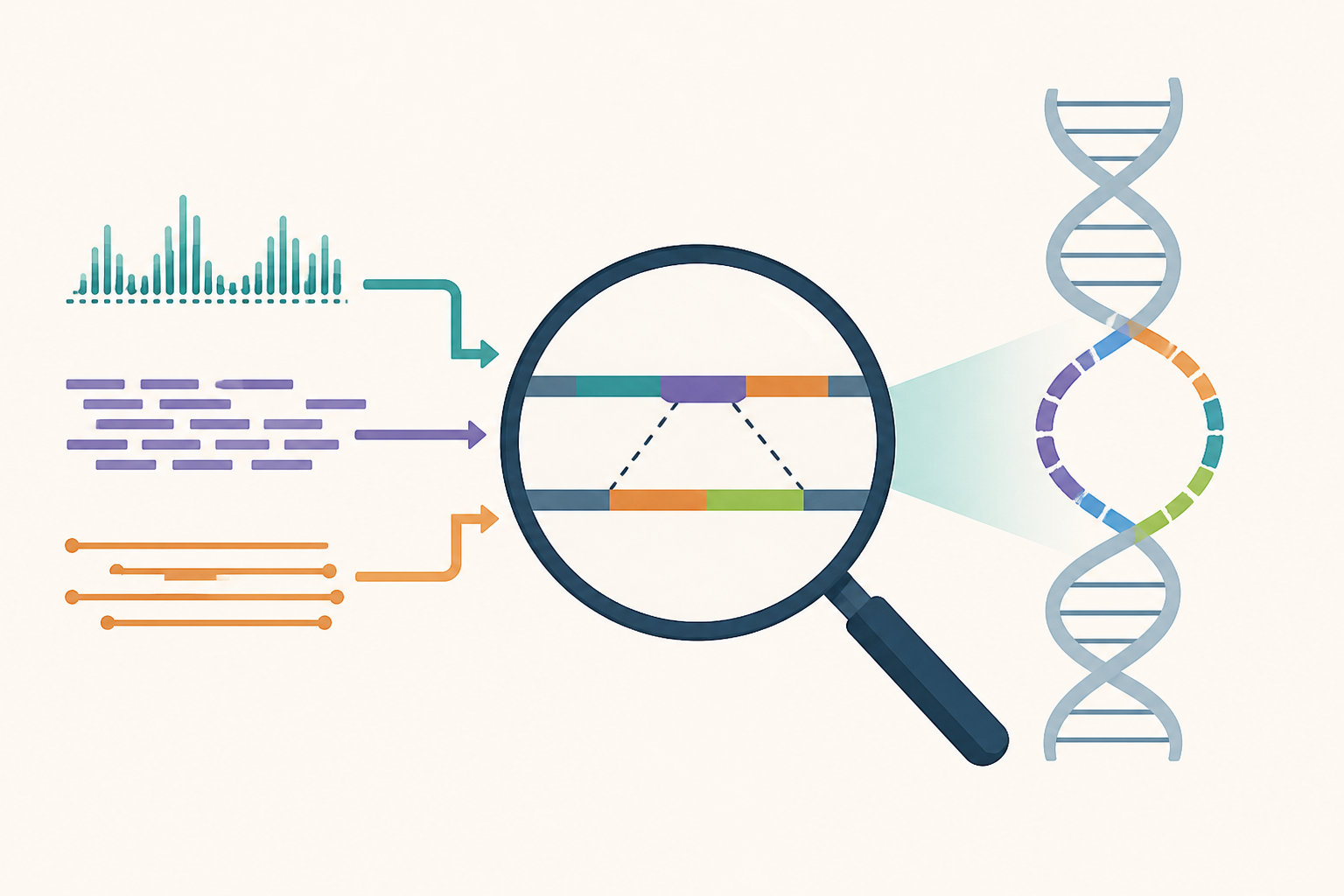
- HitSV is an alignment-based structural variant (SV) detection tool that supports long-read, short-read, and hybrid sequencing data by modeling the interaction between genomic repetitiveness and signature intensity to improve detection in complex and repetitive regions.
- The method innovates in three core stages: SV site recognition using repetitiveness- and signature-density-aware breakpoint detection; progressive SV signature clustering that refines breakpoint probability distributions; and haplotype-resolved local assembly with unitig-centered de Bruijn graphs for accurate SV reconstruction and genotyping.
- Benchmarking across 102 human datasets and six nonhuman species demonstrated that HitSV outperforms 13 state-of-the-art SV callers, achieving higher genotype F1 scores and greater sensitivity, particularly in repetitive regions and for complex SVs, while requiring lower long-read coverage.
- HitSV effectively detects complex structural variations (CSVs) characterized by clustered breakpoints and multi-event architectures, showing superior performance in phased and haplotype-resolved SV reconstruction compared to existing methods, with validated improvements in Mendelian consistency in trio datasets.
- Application to large-scale datasets, including the 3,202-sample 1000 Genomes Project and 557 Chinese individuals from the China 100K Genomes Project, revealed substantial increases in SV discovery, especially in repetitive and tandem repeat regions, uncovering novel population-specific and complex SVs with potential functional relevance.


