Synthetic super-enhancers enable precision viral immunotherapy
Nature • • health
Key Points:
- Researchers developed a custom destination vector for efficient Golden Gate cloning of enhancer fragments, incorporating a NanoLuc reporter cassette and a bacterial ccdB suicide cassette for selection, based on the EMMA Golden Gate system; a variant with PiggyBac transposase sites was made for long-term differentiation experiments.
- A bioinformatics pipeline reanalyzed SOX2 ChIP-seq and H3K27ac data from glioma stem cells (GSCs) to identify 1,721 GSC-specific SOX2 enhancer peaks, which were used to design a 160 bp oligonucleotide pool for cloning and functional screening.
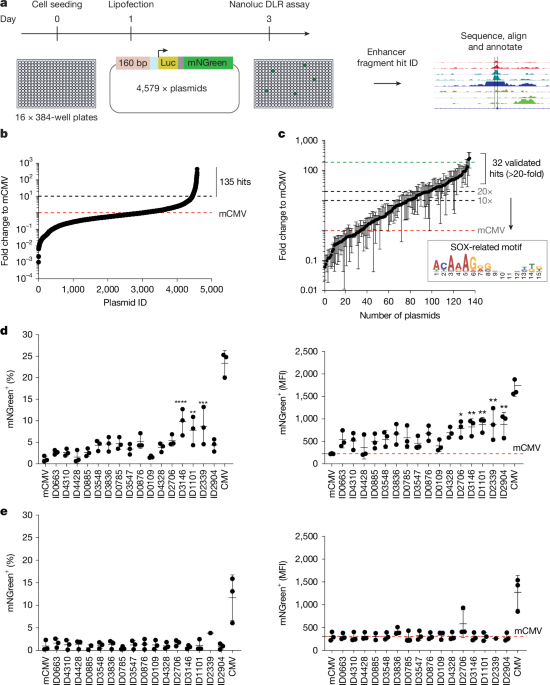
- An arrayed plasmid library of 4,579 enhancer fragments was constructed via PCR amplification and Golden Gate cloning, and screened in 384-well plates using a NanoGlo Dual-Luciferase assay to identify enhancers with strong activity, validated by sequencing and genomic mapping.
- Extensive molecular and cellular methods were employed, including immunocytochemistry, flow cytometry, RNA isolation and RT-qPCR, western blotting, protein-DNA interaction assays (EMSA), and chromatin immunoprecipitation sequencing (ChIP-seq) for SOX2 and SOX9, to characterize enhancer function and transcription factor binding in GSCs.
- In vivo and ex vivo models, including human brain slice cultures, zebrafish embryos, and mouse glioblastoma transplantation with intratumoral AAV delivery of therapeutic constructs, were used to evaluate enhancer-driven transgene expression and therapeutic efficacy, supported by single-cell RNA sequencing and immune profiling.


