AI Generated Image
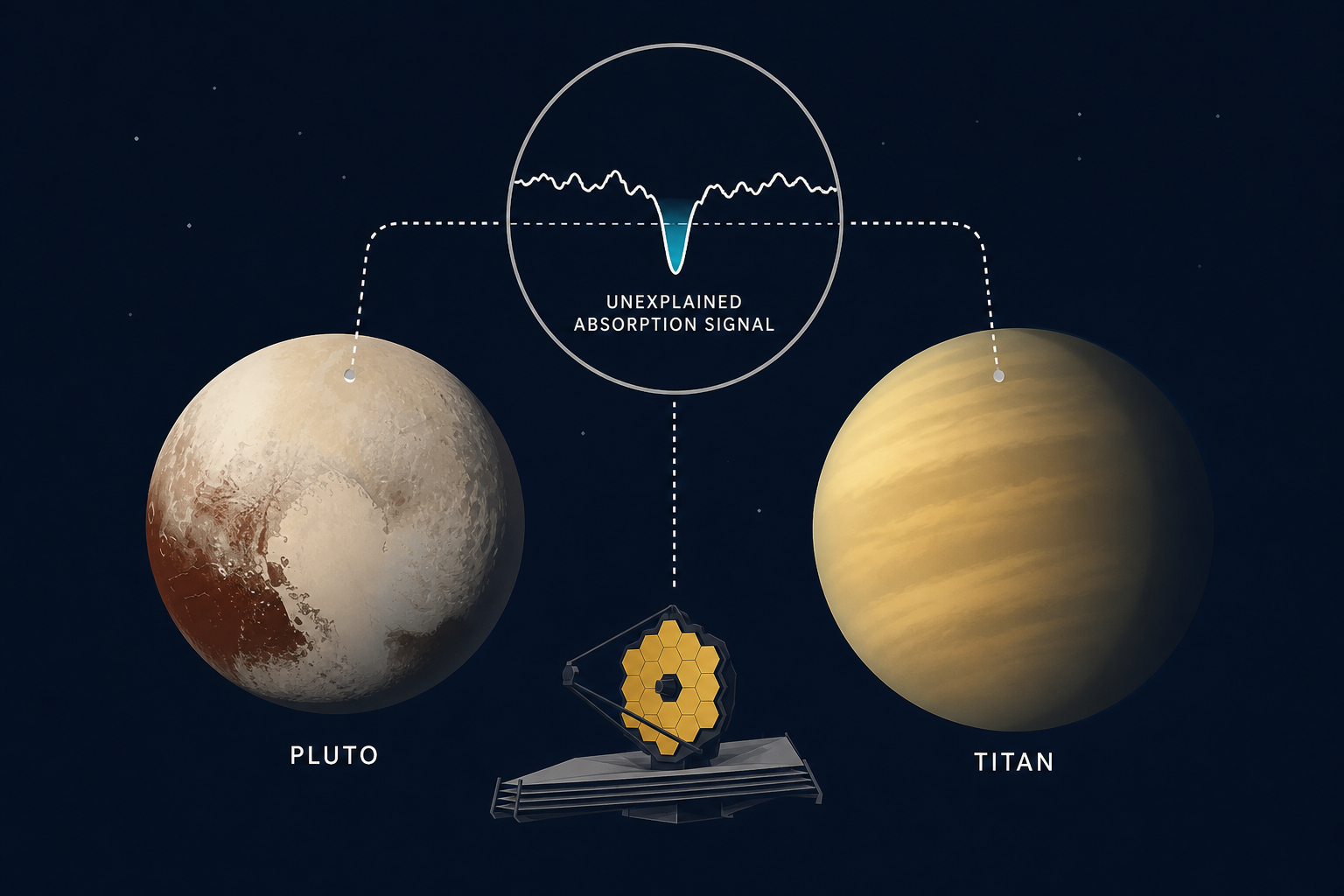
The James Webb Space Telescope has detected the same unexplained absorption signal on the surfaces of Pluto and Titan — two frozen worlds with very different environments but methane-and-nitrogen chem
Space Daily • • general
Key Points:
- The James Webb Space Telescope has detected an unexplained absorption feature at about 5.11 micrometres in the mid-infrared spectra of both Pluto and Titan, indicating a shared surface characteristic despite their differences.
- This spectral dip, observed on the surfaces rather than atmospheres of both worlds, does not match any known molecules measured in laboratories to date and remains unidentified.
- Pluto and Titan share a nitrogen and methane-based chemistry, which likely produces complex organic molecules, suggesting the feature may be linked to similar chemical processes on both bodies.
- The difference in the shape and width of the absorption feature between Pluto and Titan hints that related but distinct materials might be responsible on each world.
- Future work involves more detailed Webb observations to map the feature's distribution and laboratory experiments simulating methane-nitrogen ices to identify the exact compound causing this spectral signature.


