The physics of no return: What actually happens if you get pulled into a black hole
The Brighter Side of News • • science
Key Points:
- In 1916, Karl Schwarzschild mathematically predicted that a sufficiently dense mass could create a black hole, a region where gravity prevents anything, including light, from escaping; modern science has since imaged black hole shadows and detected gravitational waves from their collisions.
- The event horizon marks the boundary beyond which matter cannot return to the observable universe, with supermassive black holes like Sagittarius A* at the centers of galaxies having immense mass concentrated in relatively small volumes.
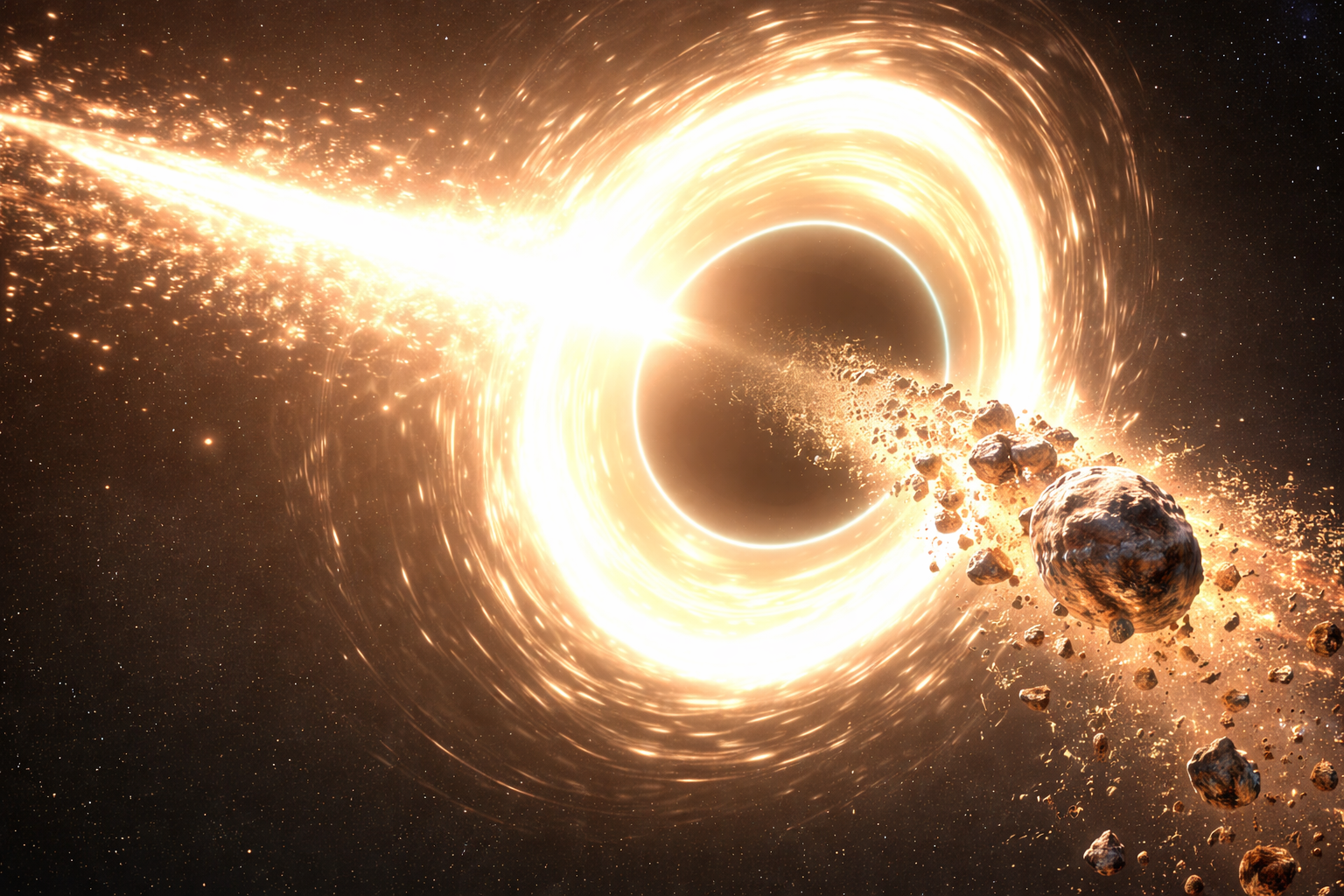
- Objects falling into black holes undergo extreme tidal forces causing "spaghettification," but supermassive black holes exert less severe tidal forces near their horizons, allowing matter to cross with less immediate destruction while forming accretion disks and sometimes emitting relativistic jets.
- Time dilation near black holes causes observers outside the event horizon to see infalling objects slow down and freeze, while the objects themselves experience no change in their own time perception, highlighting unresolved questions about the fate of matter inside black holes.
- Stephen Hawking's prediction of black hole radiation introduces the black hole information paradox, questioning whether information is lost or preserved, and black holes remain crucial to understanding the unification of general relativity and quantum mechanics.


