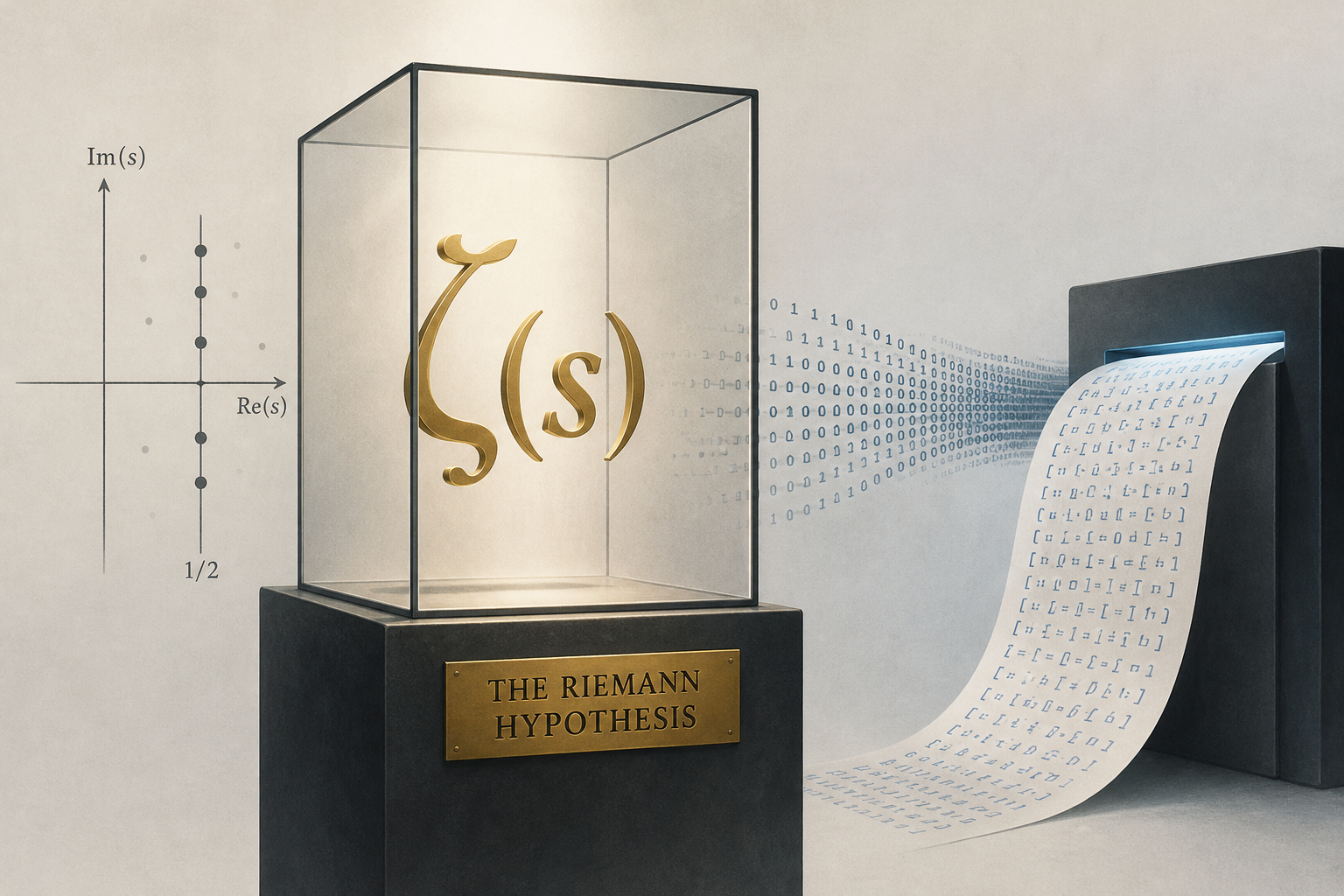
AI Image
'The sacred object in mathematics': The Riemann hypothesis, AI and a proof no human can read
Phys.org • • business
Key Points:
- Turkish American mathematician Levent Alpöge announced a proof of the generalized Riemann hypothesis, aided by AI, marking a significant AI-assisted mathematical breakthrough.
- The Riemann hypothesis, posed in 1859, concerns the distribution of prime numbers and has remained unproven despite extensive efforts and partial verifications of trillions of zeros.
- Alpöge published his proof as over 17 million lines of code in the Lean formalization software, enabling computer verification but lacking a human-readable explanation due to its immense length.
- While the proof is considered highly likely correct by the Lean and MathLib communities, it has not yet been fully understood or verified by human mathematicians, highlighting challenges in AI-assisted proofs.
- Concurrently, a traditional human-only proof by Alessandro Maria Masullo was also announced but faced immediate scrutiny and potential issues, underscoring the evolving landscape of mathematical proof validation.


