AI Generated Image
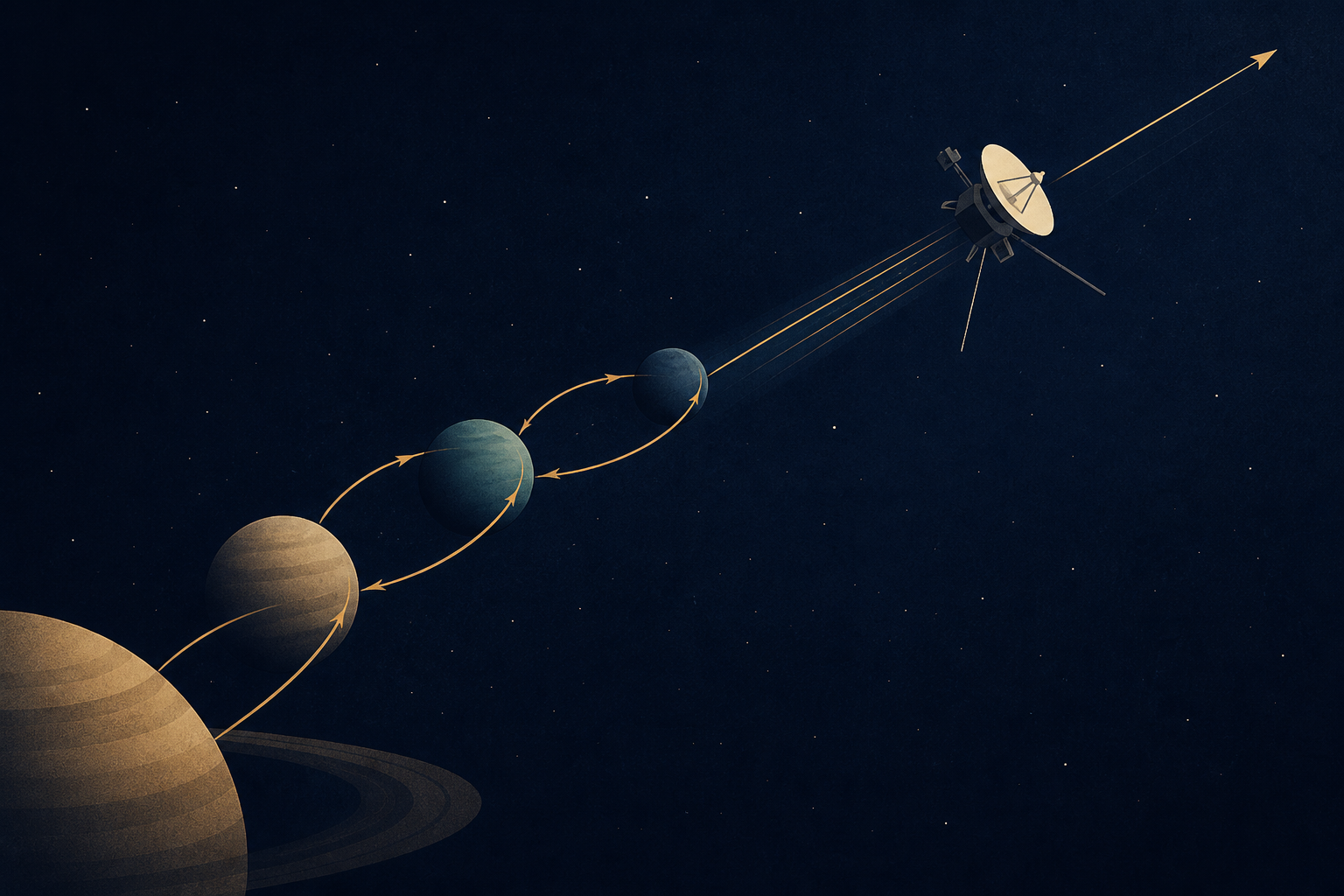
Voyager 1 has no engine running. The 38,000-mile-per-hour speed it has held since its Saturn flyby in 1980 is borrowed momentum from planets it grazed more than four decades ago, and that free ride ca
Space Daily • • science
Key Points:
- Voyager 1 is coasting through space, propelled by momentum gained from gravity assists during flybys of Jupiter in 1979 and Saturn in 1980, rather than by any onboard engine.
- The spacecraft’s current speed of about 38,000 miles per hour is a legacy of these planetary encounters, which redirected its trajectory out of the solar system on an escape path.
- On November 18, 2026, Voyager 1 will reach a distance from Earth equal to one light-day, meaning radio signals will take 24 hours to travel each way, highlighting the immense scale of its journey.
- Although Voyager 1’s scientific instruments are gradually shutting down due to power limitations, its physical motion through space will continue indefinitely, driven by inertia rather than active propulsion.
- The mission’s success lies both in the initial gravity-assisted trajectory and in the long-term operation and communication with the spacecraft, enabling humanity to track it as it ventures far beyond the heliosphere.


