AI Image
White Dwarf’s Radio Pulses Reveal Storms on Its Sun-Like Companion
Sci.News • • science
Key Points:
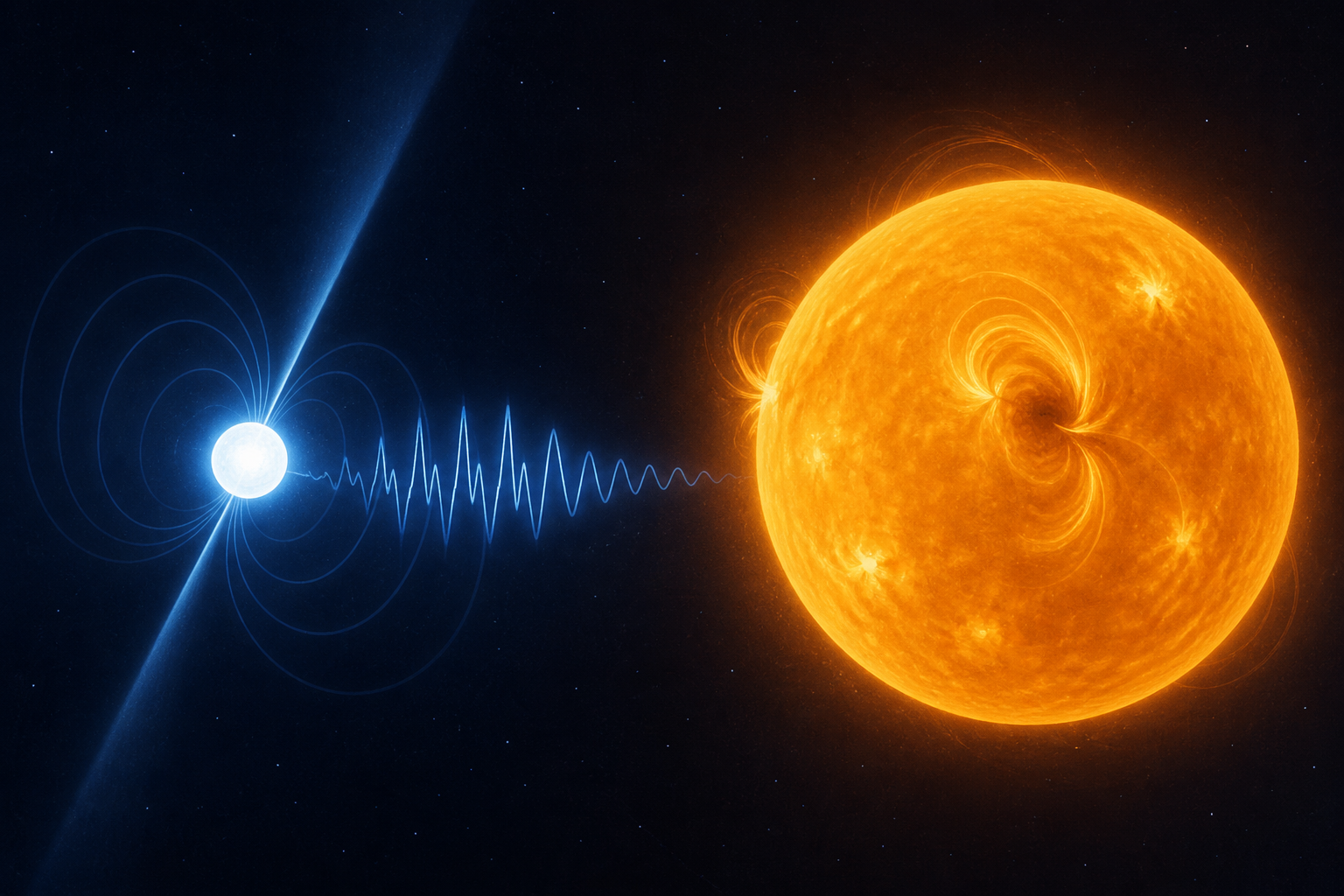
- Astronomers at Curtin University and ICRAR discovered a white dwarf named GPM J071507-114153 emitting radio pulses every 7.9 minutes while orbiting a Sun-like G-type star, marking the first such detection with a solar analog companion.
- This binary system belongs to the rare class of long-period transients (LPTs), which switch their radio emissions on and off over minutes to hours; only about a dozen LPTs are known so far.
- The clarity of the radio signal allowed researchers to track the white dwarf’s orbital motion, confirming that the pulses originate from near or on the white dwarf itself.
- Analysis of over 100 hours of radio data also revealed stellar flares on the Sun-like star and the white dwarf passing behind a stellar prominence, showcasing magnetic activity similar to aurorae on Earth.
- These findings, highlighting the ability to study distant stellar storms via radio wavelengths, were published in the journal Nature Astronomy.


