AI Generated Image
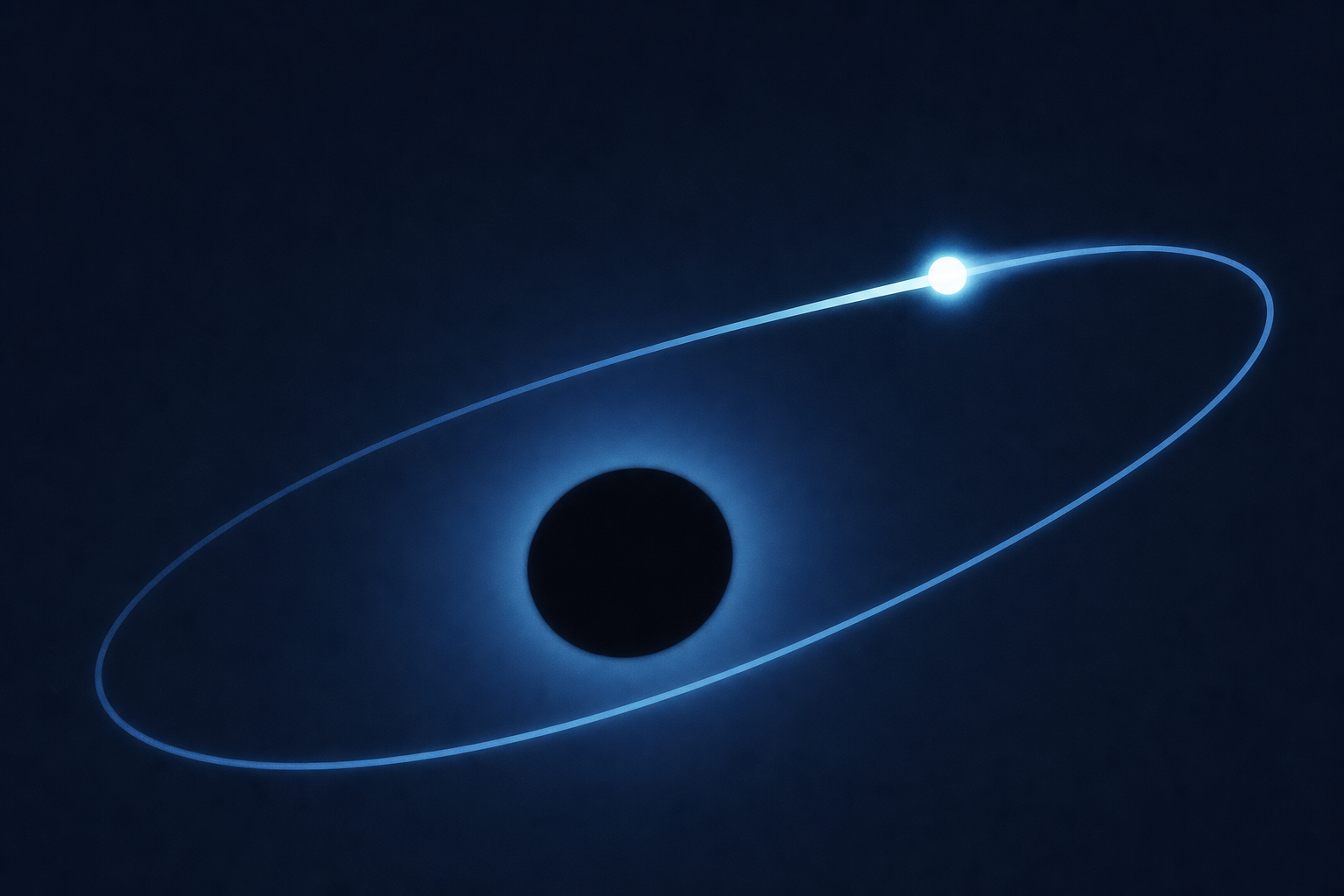
A star near the centre of our galaxy reaches almost 3 per cent of the speed of light as it is whipped around something four million times the mass of the Sun that emits no light of its own — and track
Space Daily • • general
Key Points:
- The star S2 orbits the supermassive black hole Sagittarius A* at the Milky Way’s center, accelerating to about 7,650 km/s—approximately 2.55% of the speed of light—allowing astronomers to observe relativistic effects predicted by Einstein.
- Two independent teams led by Reinhard Genzel and Andrea Ghez tracked S2’s orbit for nearly 30 years, using advanced infrared imaging techniques to penetrate galactic dust and measure the mass and compactness of the unseen central object.
- S2’s highly elliptical orbit, completed in under 16 years, revealed that about 4.3 million solar masses are concentrated within its closest approach, ruling out alternatives to a supermassive black hole due to stability constraints.
- Observations detected relativistic phenomena such as gravitational redshift, the transverse Doppler effect, and Schwarzschild precession in S2’s orbit, confirming general relativity in a strong gravitational field far beyond the Solar System’s environment.
- The 2020 Nobel Prize in Physics honored Penrose for theoretical black hole formation and Genzel and Ghez for empirical discovery of the Milky Way’s central supermassive compact object, with S2’s orbit providing critical evidence complemented by the 2022 Event Horizon Telescope image of Sagittarius A*.


