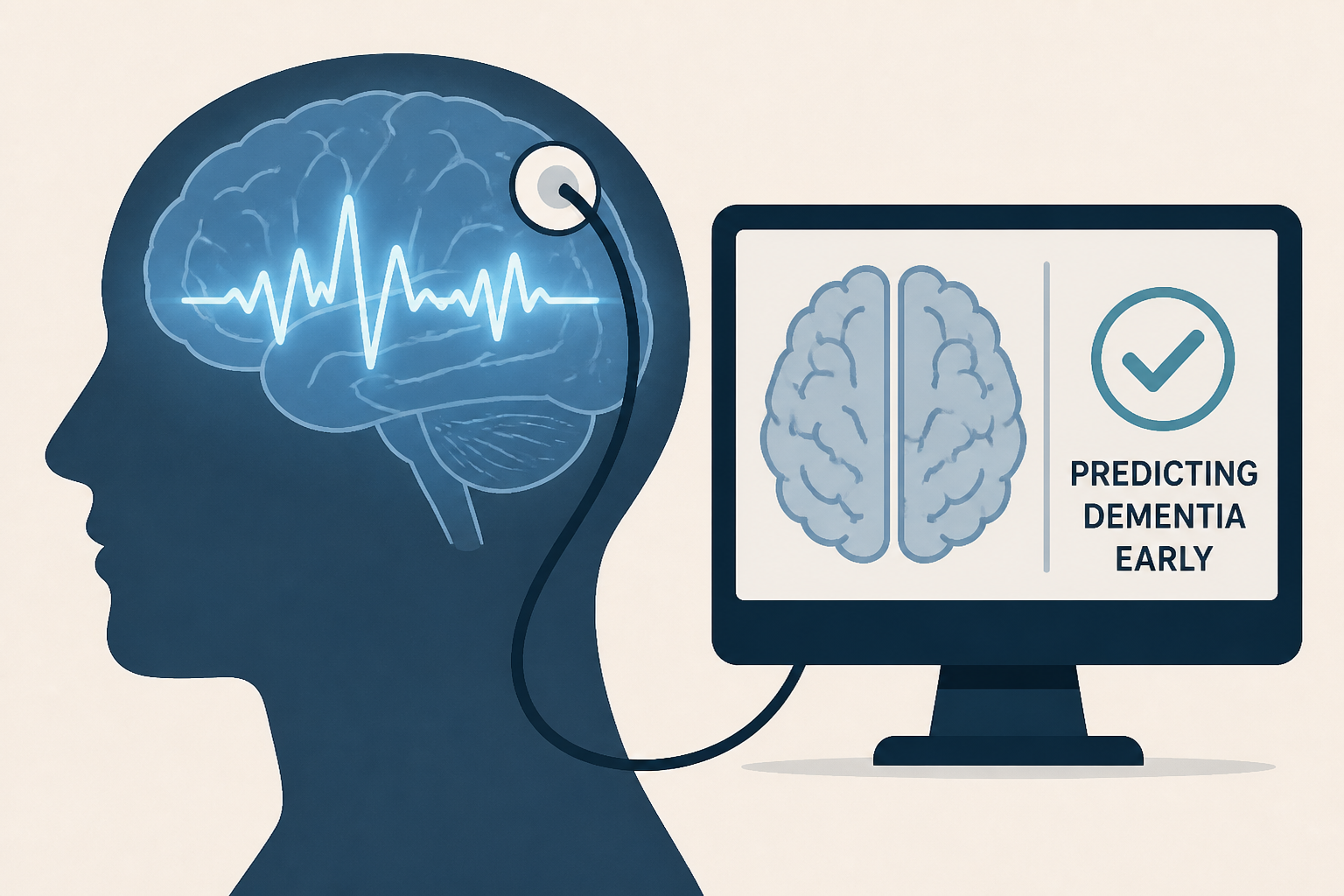
AI Generated Image
Brain Test Could Predict Dementia Before Doctors Can See It, Study Suggests
Newsweek • • health
Key Points:
- A new study from Amsterdam UMC suggests that measuring the difference between a person's brain age (estimated via AI analysis of MRI scans) and their actual age can predict the risk of developing dementia years before traditional visual assessments detect changes.
- The research found that for every year a brain appears older than the person's real age, the risk of dementia increases by 6%, especially useful in early stages when cognitive decline is subtle.
- The study analyzed 799 patients over 22 years, focusing on those with subjective cognitive decline (SCD) and mild cognitive impairment (MCI), finding brain age estimates particularly predictive for SCD patients but less so for MCI cases.
- Patients whose brain appeared at least 2.6 years younger than their actual age had up to a 99% chance of not developing dementia within the next two to ten years, highlighting the potential for early risk stratification.
- Researchers aim to further validate this AI-based brain age approach in clinical settings and explore how it can complement existing MRI assessments to improve early dementia diagnosis and patient management.


![Google Pixel screen savers add new styles, swipe gesture [Gallery]](https://media-cdn.cashwalklabs.io/https%3A%2F%2Fs3.us-west-2.amazonaws.com%2Fimages.cashwalklabs.io%2F0_admin%2Fnews-ai-images%2F01a020c8-02ff-7739-94ec-8cdc8c008429.webp?format=webp&w=120&h=80)


