Demography and life histories across the Roman frontier in Germany 400-700 ce
Nature • • world
Key Points:
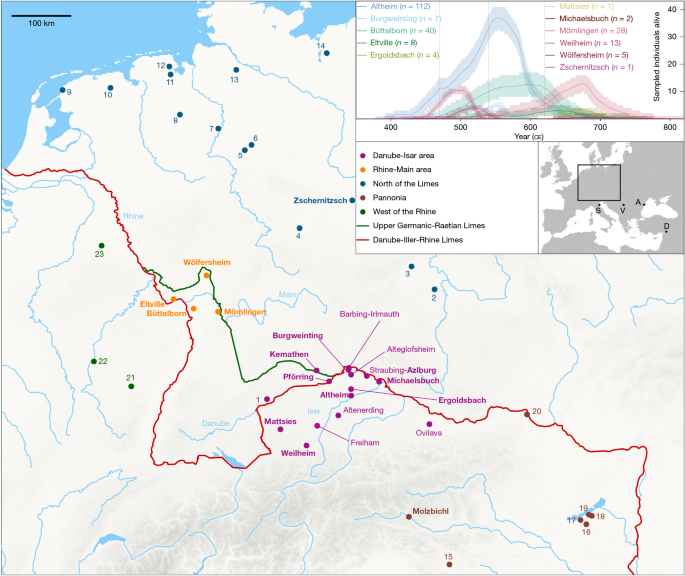
- A genomic study of 221 Early Medieval individuals from Southern Germany reveals three distinct ancestry phases between 400 and 660 CE, showing major demographic shifts involving northern European, Roman Southeastern European, and Iron Age Central Italian ancestries.
- The emergence of Row-Grave cemeteries around 450 CE coincides with increased genetic diversity and population substructure, reflecting regional mobility and admixture between local northern ancestry groups and Roman provincial populations.
- Life-history analyses indicate higher infant mortality in boys, a life expectancy around 40-43 years, predominantly lifelong monogamy, strict incest avoidance, and patrilocal or flexible bilateral residence patterns consistent with Christian and Roman inheritance and marriage norms.
- Genetic data show extensive transregional kinship networks across Central Europe, suggesting migration of small kin groups rather than mass population movements, with implications for the spread of early Germanic dialects in Southern Germany.
- The study integrates archaeological, isotopic, and historical evidence to challenge traditional views of the Late Antique to Early Medieval transition, highlighting complex local demographic processes within a framework of Roman legacy and emerging medieval social structures.


